Choosing between synthetic turf and natural grass for your South Texas property is more than a simple aesthetic decision. For homeowners and businesses in Corpus Christi, San Antonio, Brownsville, and Harlingen, it's a practical choice that impacts your wallet, your weekend, and your water bill. Synthetic turf offers a consistently green, low-maintenance lawn designed to withstand our climate, while natural grass provides a traditional, organic surface that demands constant care and resources. This guide breaks down the real-world factors to help you make an informed investment in your landscape.
Choosing the Right Lawn for South Texas Realities
For property owners anywhere from San Antonio down to the Rio Grande Valley, selecting the right lawn is a critical decision. Our region’s punishing heat, unpredictable rainfall, and challenging soil conditions make this more than just a matter of looks. It's a practical choice about long-term performance, cost, and the amount of work you're willing to invest.
Key Factors for Your Property
The best choice for your property depends on your specific needs and priorities. Whether you're managing a commercial property in Brownsville or a family home in Harlingen, the right solution is the one that aligns with your goals.
Consider these key points:
- Water Conservation: How critical is lowering your water bill and conserving a vital resource during our frequent droughts?
- Maintenance Commitment: How much time and money are you prepared to spend on mowing, fertilizing, and pest control?
- Durability Needs: Will your lawn endure heavy use from children, pets, or customer foot traffic?
- Long-Term Investment: Are you focused on a lower upfront cost, or a better return on investment over the next 10-15 years?
Considering the bigger environmental picture is also smart. Understanding climate change adaptation strategies for Texas industries can help you make a landscaping decision that’s not just for today, but for a more resilient future.
Comparing Turf and Grass at a Glance
This guide is designed to provide a clear, practical framework for your decision. Let’s move past the basics and dig into a real comparison. Here's a quick look at what really separates these two popular choices.
| Feature | Natural Grass | Synthetic Turf |
|---|---|---|
| Upfront Cost | Lower initial cost for sod or seed. | Higher initial investment for materials and installation. |
| Water Needs | High; requires frequent watering, especially in summer. | Extremely low; only needs occasional rinsing to clean. |
| Maintenance | High; requires mowing, weeding, fertilizing, aeration. | Very low; needs occasional brushing and debris removal. |
| Durability | Can develop bare spots and mud under heavy use. | Extremely durable; withstands heavy foot traffic well. |
| Appearance | Can turn brown in drought or dormancy. | Stays consistently green and pristine all year round. |
| Surface Temp | Stays naturally cooler in direct sun. | Can become hot in direct sun but cools with rinsing. |
At Fischer Landscaping, we have years of experience helping South Texas property owners find and install the perfect ground cover. Our expertise in both traditional landscaping and modern solutions like artificial turf installation ensures your outdoor space is beautiful, functional, and perfectly suited to our local climate.
A Financial Breakdown of Installation and Lifetime Costs
When weighing synthetic turf against natural grass, the conversation almost always starts with price. While natural grass appears to be the more affordable option initially, a closer look at the total cost of ownership reveals a different story. To make a smart financial decision, you must consider the investment over the entire life of your lawn.
Upfront Installation: A Tale of Two Investments
Installing a natural grass lawn has a relatively low upfront cost. You'll pay for soil preparation, sod or seed, and the labor to install it. For a typical 1,000-square-foot lawn in South Texas, this can range from $1 to $3 per square foot. However, the hidden cost lies in the establishment period, which demands significant water and attention to ensure the grass takes root.
Synthetic turf, on the other hand, requires a larger upfront investment. The professional installation process is more involved, including ground preparation, a sub-base for drainage, the premium turf product, infill material, and expert labor. The cost typically ranges from $8 to $20 per square foot. While this figure is significant, it’s a one-time expense that paves the way for years of minimal spending.
Thinking Long-Term: The Real Cost Emerges
The true financial picture becomes clear when you project costs over a decade. A natural lawn is a continuous expense. For property managers and homeowners from Corpus Christi to Brownsville, the largest and most unpredictable cost is water, especially during our long, dry summers.
The spending doesn't stop there. The maintenance for natural grass is a relentless cycle:
- Mowing: Fuel, equipment maintenance, or hiring a lawn service adds up quickly.
- Fertilizing: Required several times a year to maintain health and color.
- Weed & Pest Control: An ongoing battle requiring chemical treatments or manual labor.
- Aeration & Seeding: Necessary to address compacted soil and bare patches.
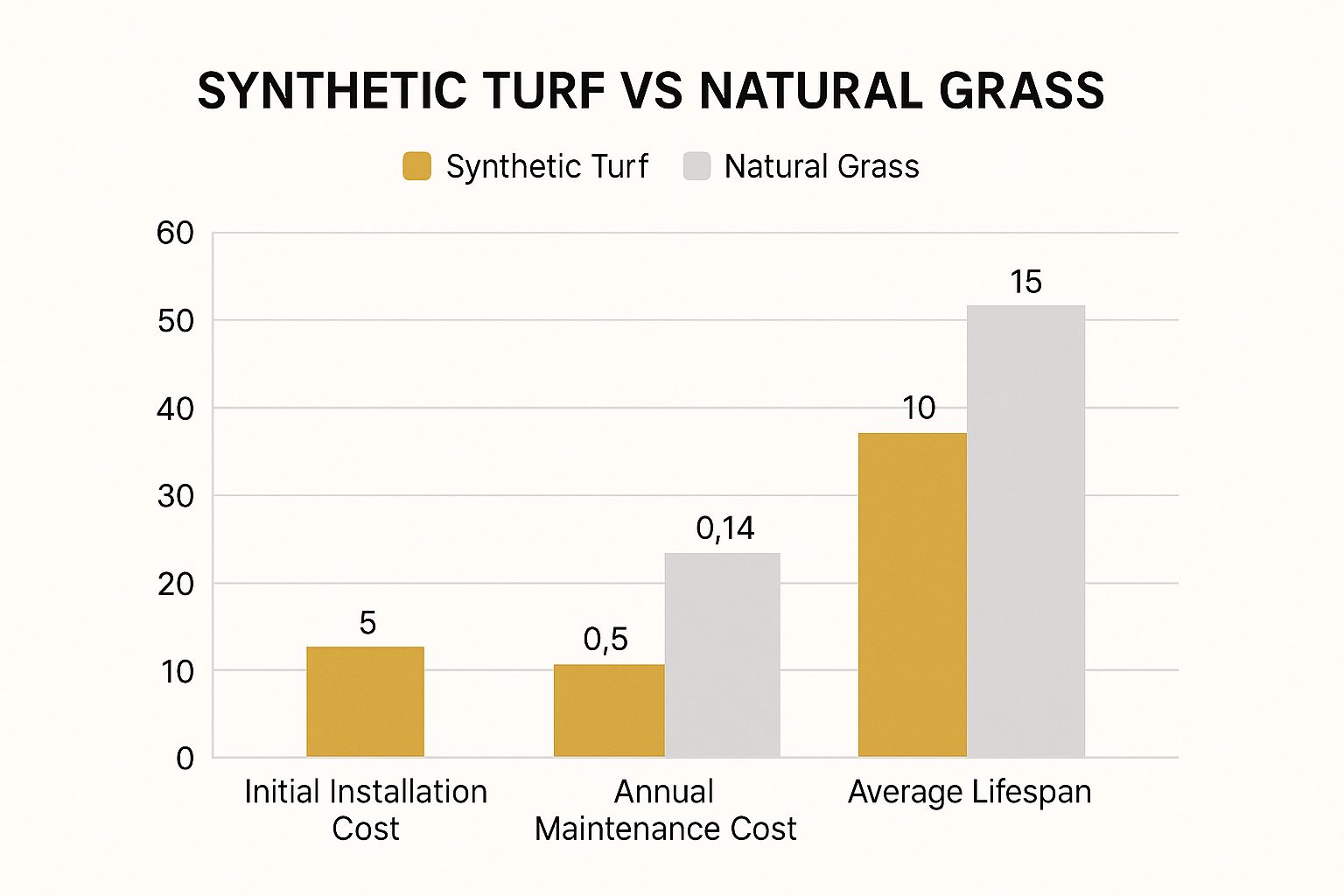
These tasks can easily cost $500 to $2,000 annually, depending on your lawn's size and whether you handle the work yourself. Let’s compare the estimated 10-year costs for a 1,000-square-foot lawn.
10-Year Ownership Cost: Turf vs. Grass (1,000 sq ft)
| Cost Factor | Natural Grass (10-Year Estimate) | Synthetic Turf (10-Year Estimate) |
|---|---|---|
| Initial Installation | $1,000 – $3,000 | $8,000 – $20,000 |
| Watering | $3,000 – $8,000+ | $0 (minimal for cleaning) |
| Mowing/Equipment | $2,000 – $5,000 | $0 |
| Fertilizer/Chemicals | $1,000 – $2,500 | $0 |
| Aeration/Reseeding | $500 – $1,500 | $0 |
| Total 10-Year Cost | $7,500 – $20,000+ | $8,000 – $20,000 |
As you can see, the long-term numbers tell a completely different story. What starts as a cheaper option can easily end up costing just as much, if not more, than synthetic turf over time—not to mention the constant work involved.
The Return on Investment with Synthetic Turf
Artificial grass flips the financial script. Once installed, the ongoing costs are negligible. You eliminate watering, mowing, and chemical applications. Maintenance is reduced to occasional rinsing, brushing high-traffic areas, and clearing away leaves.
Over its 15-20 year lifespan, a synthetic lawn saves a property owner thousands of gallons of water and countless hours of work. The break-even point—where savings on water and maintenance offset the initial installation cost—typically occurs within 5 to 7 years.
This transforms your lawn from a recurring expense into a predictable, long-term asset. At Fischer Landscaping, we use top-tier materials and a meticulous installation method to maximize that return. A professional job is key to unlocking the true financial benefits of synthetic turf. Learn more about our professional artificial grass installation process and see how doing it right from the start pays off.
Comparing Maintenance Demands in the Texas Heat
While cost is a major factor, the biggest difference between synthetic turf and natural grass is often the time and effort required for upkeep. In the relentless South Texas climate, maintaining a natural lawn can feel like a part-time job—a constant battle against heat, humidity, and pests. The choice you make will directly impact how you spend your weekends for years to come.
The Unending Cycle of Natural Grass Care
Owning a natural lawn in Corpus Christi or San Antonio means committing to a never-ending cycle of maintenance. Our humid summers cause rapid grass growth, often requiring mowing at least once a week.
The real work, however, involves:
- Water Management: During our notorious dry spells, you must water deeply and frequently to keep roots alive, leading to high water bills.
- Weed and Pest Control: South Texas is home to pests like chinch bugs and fire ants that can destroy a lawn quickly. Constant vigilance and treatment are necessary.
- Seasonal Chores: Beyond weekly mowing, you'll need to aerate compacted soil and overseed bare spots that appear after a brutal summer.
This demanding schedule is a significant commitment. For homeowners looking to manage it, Fischer Landscaping offers practical South Texas lawn care tips to help.
The Low-Maintenance Reality of Synthetic Turf
Now, imagine a different scenario: a perfectly green lawn without the back-breaking labor. For busy homeowners and commercial property managers in Harlingen or Brownsville, synthetic turf isn't just a convenience—it’s a game-changer.
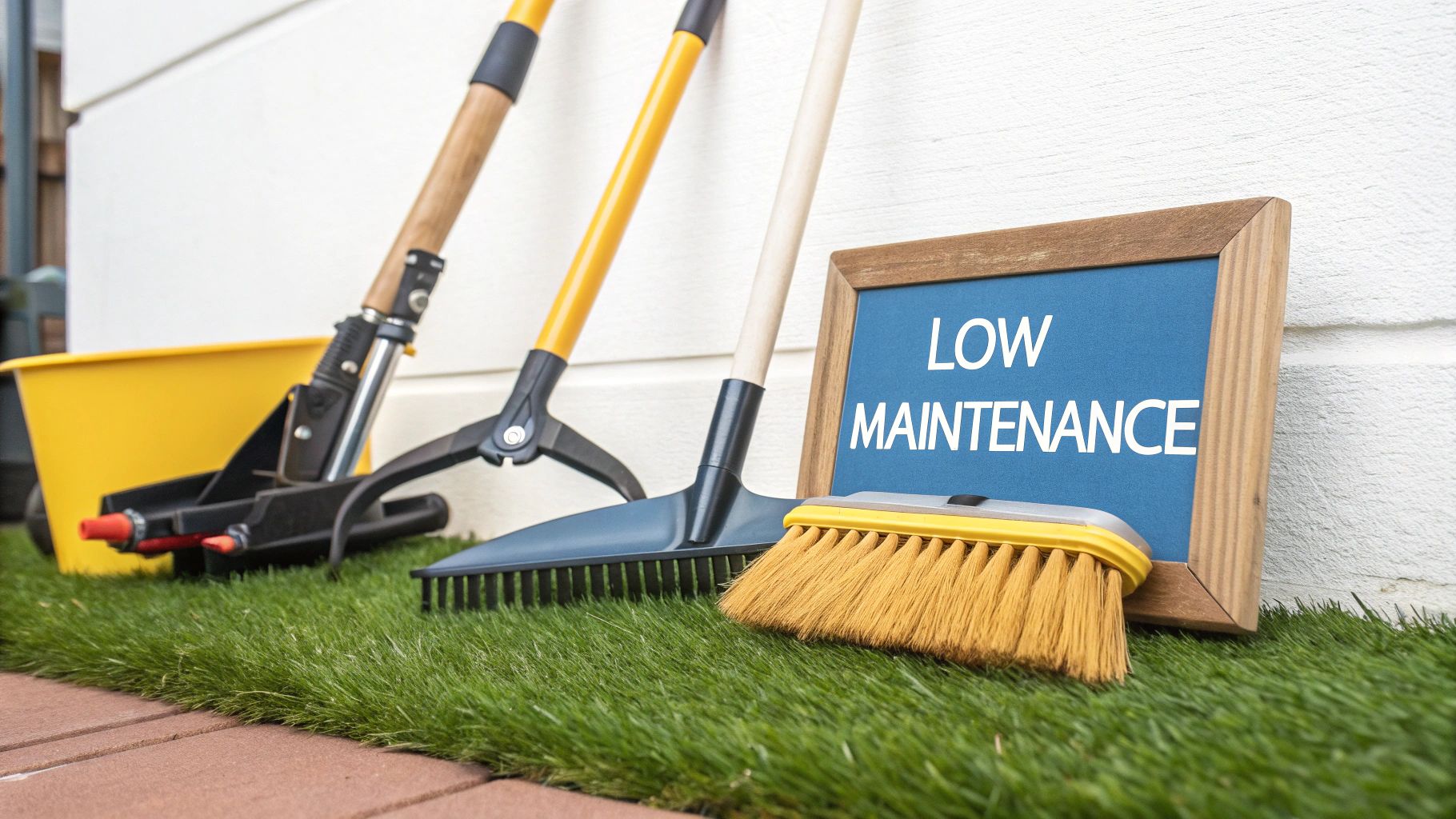
The "maintenance" for artificial grass is remarkably simple:
- Rinsing: A quick spray with a hose removes dust, pollen, and pet messes.
- Brushing: A stiff broom can fluff up fibers in high-traffic areas in just minutes.
- Debris Removal: Use a leaf blower or rake to clear leaves and twigs.
The real win is what you don't have to do. With synthetic turf, you can permanently cross mowing, watering, fertilizing, and weeding off your to-do list, reclaiming valuable time and energy.
This hands-off approach not only saves you time but also guarantees a beautiful, vibrant lawn year-round, no matter what the Texas weather brings.
Why Professional Installation is Key to a Low-Maintenance Lawn
The long-term, hassle-free benefits of synthetic turf depend entirely on the quality of the installation. A rushed job or a poorly prepared base can lead to drainage problems, wrinkles, and uneven surfaces. This is where professional expertise matters.
At Fischer Landscaping, our meticulous installation process includes a robust, permeable sub-base engineered for rapid drainage, even during heavy Texas downpours. By getting the foundation right, we ensure your turf looks and performs flawlessly with minimal effort from you.
Ready to reclaim your weekends and enjoy a perfect lawn without the constant work? A professionally installed synthetic turf system is the ultimate solution. Contact Fischer Landscaping today for a personalized quote and discover how a low-maintenance lawn can transform your South Texas property.
Evaluating Durability, Aesthetics, and Performance
Beyond costs and maintenance, the true value of a lawn lies in how it looks and performs day after day. In South Texas, that means withstanding scorching sun, heavy foot traffic, and torrential downpours. Your lawn is a major component of your property’s curb appeal, making its long-term performance and appearance critical.
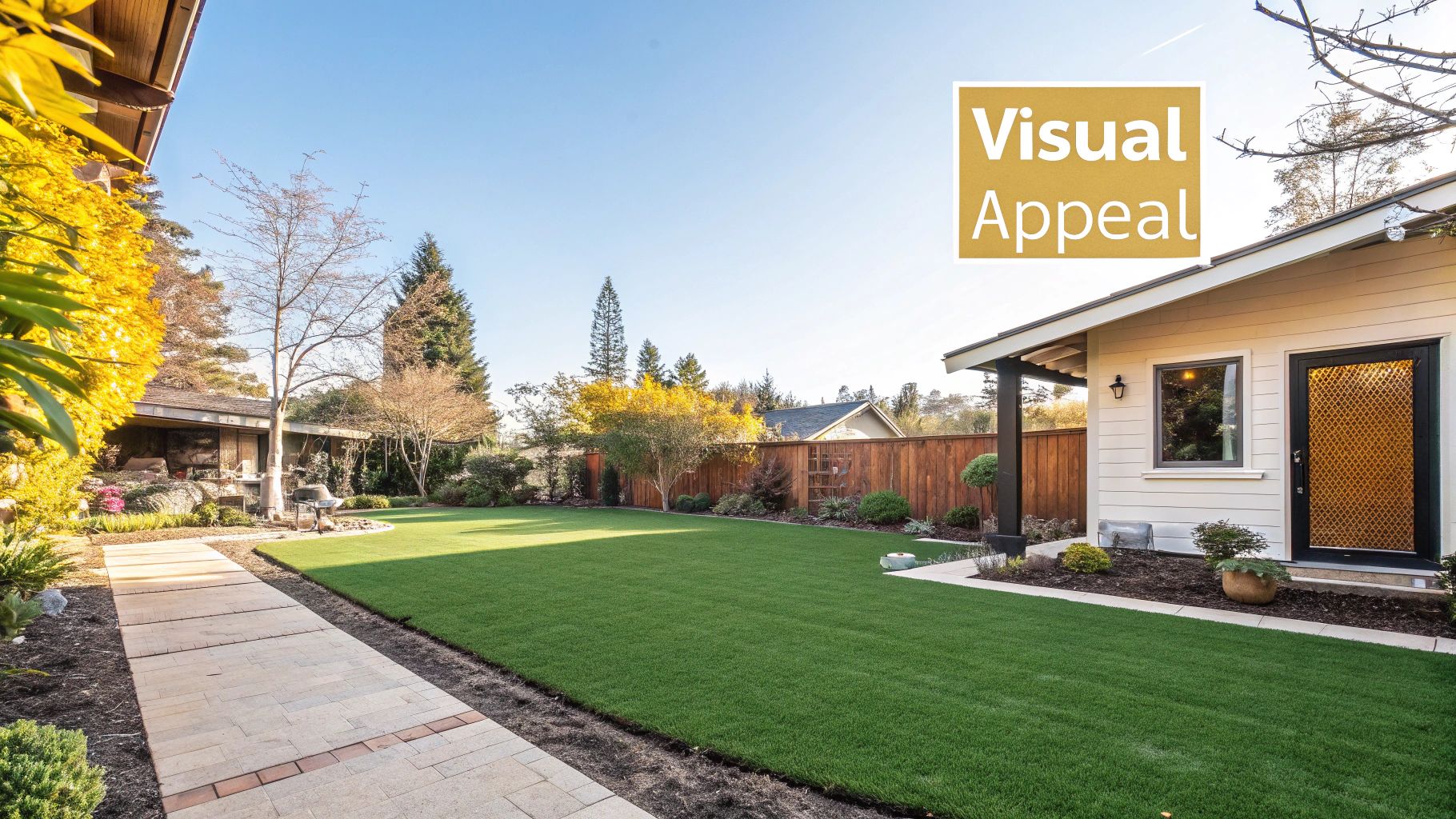
Let's get practical and compare how these options function in a real-world setting. This will help you visualize how each fits into your property and lifestyle over the long haul. We’ll examine resilience, year-round aesthetics, and overall performance to guide your decision.
Resilience Under Pressure
For most South Texas families and businesses, a lawn is a high-traffic area. Children, pets, and customers can quickly wear down natural grass, leaving behind a patchy, muddy mess. This is where synthetic turf excels.
- Heavy Foot Traffic: Quality artificial turf is engineered to withstand constant use. Its durable fibers bounce back, maintaining a full, even look in play areas and walkways without developing ruts or bare spots.
- Pet-Friendly Performance: Dogs can wreak havoc on a natural lawn, causing yellow spots and digging holes. Synthetic turf eliminates these issues, offering a tough, easy-to-clean surface.
- Weather Resistance: Modern turf is UV-stabilized to prevent fading under the relentless Texas sun and is designed for rapid drainage, preventing muddy puddles after storms.
Natural grass is far more fragile. Heavy use compacts the soil, suffocating roots and leading to worn-out dirt patches. Even the most resilient grass varieties need time to recover from wear and tear.
Year-Round Aesthetics and Visual Appeal
For property owners in Corpus Christi and San Antonio who demand flawless curb appeal, the visual consistency of synthetic turf is a game-changer. It provides a perfectly manicured look 365 days a year, regardless of drought conditions or seasonal changes.
Modern synthetic turf technology has advanced significantly. Today's premium products feature multi-toned fibers, varied blade heights, and a thatch layer that create a remarkably realistic look and feel, mimicking a healthy, natural lawn.
While beautiful at its peak, natural grass is unpredictable. It has an organic aesthetic that changes with the seasons but is also prone to issues that can mar its appearance:
- Brown Patches: A common result of water restrictions, fungal diseases, or pests.
- Shaded Areas: Grass struggles to thrive in heavily shaded spots, often resulting in thin, weak turf.
- Dormancy: Many local grass types go dormant and turn brown during cold spells or extended droughts.
The choice depends on your aesthetic priorities. If you want a flawless, evergreen lawn with no surprises, synthetic turf is the clear winner.
At Fischer Landscaping, our professional turf installations guarantee a high-quality look that enhances any property. Proper installation is key to performance, especially for water management. You can learn more by reading about common artificial turf drainage problems and their solutions.
Health, Safety, and the Environment: A Closer Look
The decision between synthetic turf and natural grass goes deeper than aesthetics and maintenance—it involves health, safety, and your property's environmental footprint. In South Texas, where water is a precious resource and our coastal environment is vital, these factors can be the deciding ones.
Let's break down the nuances to help you make a choice that aligns with your family's needs and your environmental values.
Environmental Impact and Water Conservation
In a region where drought is a constant concern, the high water consumption of a natural lawn is a significant issue. Artificial turf nearly eliminates this demand, making it a highly effective tool for water conservation from San Antonio to Brownsville.
Beyond water, consider the maintenance of a natural lawn:
- Fertilizers and Pesticides: Chemical runoff can leach into groundwater and wash into storm drains, impacting local waterways and coastal ecosystems.
- Mowing Emissions: Gas-powered lawn equipment contributes to air pollution.
Synthetic turf eliminates these issues. No chemicals, no emissions. For those focused on reducing their environmental impact, it’s a compelling choice.
By switching to synthetic turf, a typical South Texas homeowner can save over 50,000 gallons of water each year. This massive reduction in water use and chemical runoff delivers a direct, positive benefit to our local environment.
Surface Temperature and Playability
Heat is a valid concern with artificial grass, as it gets hotter than natural grass in direct sun. However, modern turf technology has addressed this issue. Advanced systems use lighter-colored infill materials and specially designed blades to dissipate heat more efficiently. A quick spray with a hose can also cool the surface in seconds, making it comfortable for play.
Natural grass, on the other hand, has a built-in cooling system through transpiration, which keeps it pleasant underfoot—a definite plus for families with young children.
Safety and Shock Absorption for Active Use
Safety is paramount, especially for children or athletes. Natural grass with its underlying soil typically offers a softer, more forgiving landing. Synthetic systems must engineer this shock absorption with specialized padding and infill.
Recent biomechanical research has quantified this. Studies show that synthetic turf can expose individuals to greater impact forces during a fall. For example, one study recorded average forehead impacts on synthetic turf at 128.8 g’s, compared to 117.9 g’s on natural grass. This suggests the artificial surface absorbs less shock. You can read the full research about these impact findings to explore the science yourself.
For a typical backyard in Harlingen, this difference may not be a major concern. However, for playgrounds or athletic areas, proper installation with a shock-absorbing underlayment is non-negotiable. At Fischer Landscaping, we design and install turf and hardscaping solutions with safety as a top priority, helping you select the right materials for a beautiful and functional project.
Making the Right Choice for Your South Texas Property
So, where do you land in the synthetic turf versus natural grass debate? After weighing the costs, maintenance, and performance, it comes down to what your property truly needs. The right choice is the one that fits your goals, your lifestyle, and your specific piece of South Texas.
Let's look at a few real-world scenarios to make your decision clearer.
Situational Recommendations for South Texas
Consider your daily life, from San Antonio down to Brownsville. Your ideal lawn becomes obvious when you match it against your reality.
-
The Busy Professional or Commercial Property Manager: For a flawless look with zero fuss, synthetic turf is the hands-down winner. It delivers a perfect, manicured green that impresses clients and tenants year-round without the need for a grounds crew.
-
The Family with Kids and Pets: If you're tired of muddy paws and torn-up grass, synthetic turf is a game-changer. It provides a durable, mud-free play zone that withstands endless activity and is easy to clean.
-
The Passionate Gardener or Nature Enthusiast: For those who enjoy lawn care and prefer a soft, cool surface for children, natural grass remains a fantastic option. It offers an organic beauty and satisfaction that only a real lawn can provide.
-
The Homeowner Under Strict HOA Rules: In many communities around Corpus Christi and Harlingen, the HOA has the final say. Always check your guidelines, as natural grass may be your only approved option.
The smartest decision aligns your property's purpose with your personal priorities. A bustling commercial storefront has different needs than a quiet family backyard. Be honest about how much time, money, and effort you are willing to invest.
Exploring various local landscaping services can also provide insight into professional installation and long-term care options for either choice.
Your Final Step: A Professional On-Site Evaluation
Ultimately, an article can only take you so far. The unique characteristics of your property—drainage, sun exposure, and soil type—are critical factors. The most important step is to get an expert on-site evaluation.
The team at Fischer Landscaping provides personalized consultations. We'll walk your property with you, listen to your goals, and offer a straightforward, honest recommendation on whether synthetic turf or natural grass is the smarter investment for your space. Let us help you make a confident choice that will add value and beauty to your property for years to come.
Ready to find the perfect lawn solution? Contact Fischer Landscaping today to request a quote and schedule your personalized consultation.
Common Questions About Turf and Grass in South Texas
The choice between synthetic turf and natural grass often comes down to a few practical questions, especially concerning our intense heat, heavy rains, and the need for long-term durability in South Texas.
Let's address some of the most common questions we hear at Fischer Landscaping.
How Hot Does Synthetic Turf Get in the Texas Sun?
This is a top concern, and rightly so. Synthetic turf does get warmer than natural grass in direct sun. However, modern turf technology has made significant strides in addressing this issue.
High-quality turf products are now designed with heat-reducing features:
- Cooling Technology: Premium turf often includes specially shaped yarns and coatings that reflect infrared light, helping to lower surface temperatures.
- Smarter Infill: Using lighter-colored sand or specialized cooling infills instead of traditional black crumb rubber significantly reduces heat absorption.
- Quick Cool-Down: A brief spray with a hose can quickly cool the surface, making it comfortable for play even on hot days.
How Does Synthetic Turf Handle Heavy Rain?
From Corpus Christi thunderstorms to tropical downpours in Brownsville, drainage is essential. A professionally installed turf system often drains more efficiently than a natural lawn on our heavy clay soil.
The key is the multi-layered sub-base we construct. This foundation of crushed rock creates a highly permeable layer that allows water to drain quickly, preventing the pooling and muddy patches common with natural grass. You can learn more about how a proper base prevents common artificial turf drainage problems.
What Is the Lifespan of Turf in South Texas?
A synthetic lawn is a long-term investment. With a high-quality product and professional installation, you can expect a lifespan of 15 to 20 years, even in our demanding climate. The materials are UV-stabilized to resist fading and degradation from the sun, ensuring your lawn stays vibrant for decades.
A note on installation: Longevity depends on the quality of the installation. A properly prepared base, secured seams, and the correct infill are crucial to prevent premature wear and maximize the value of your investment.
Are There Eco-Friendly Turf Options?
Yes. The environmental benefits are a major draw for many homeowners. Modern turf is often made from recyclable materials, and some products are 100% recyclable at the end of their life.
The biggest environmental advantage, however, is the drastic reduction in water use. By eliminating the need for sprinklers, a synthetic lawn is one of the most effective water conservation tools available—a critical benefit for everyone in South Texas.
Ready to move from questions to solutions? The expert team at Fischer Landscaping can provide a personalized, on-site evaluation to help you find the perfect lawn for your property, budget, and lifestyle.