For homeowners and property managers across South Texas, there's nothing more frustrating than investing in a beautiful synthetic lawn only to see it hold water like a swimming pool after a storm. When this happens, the culprit is almost always the same: the sub-base beneath your turf. If that foundation wasn't prepared by a professional to handle our region's heavy clay soils, that rainwater simply has nowhere to go.
This guide is designed to help you understand the common causes of artificial turf drainage problems, diagnose the issue with your own lawn, and explore practical solutions that will restore your investment and give you peace of mind.
Uncovering the Root Causes of Turf Drainage Problems
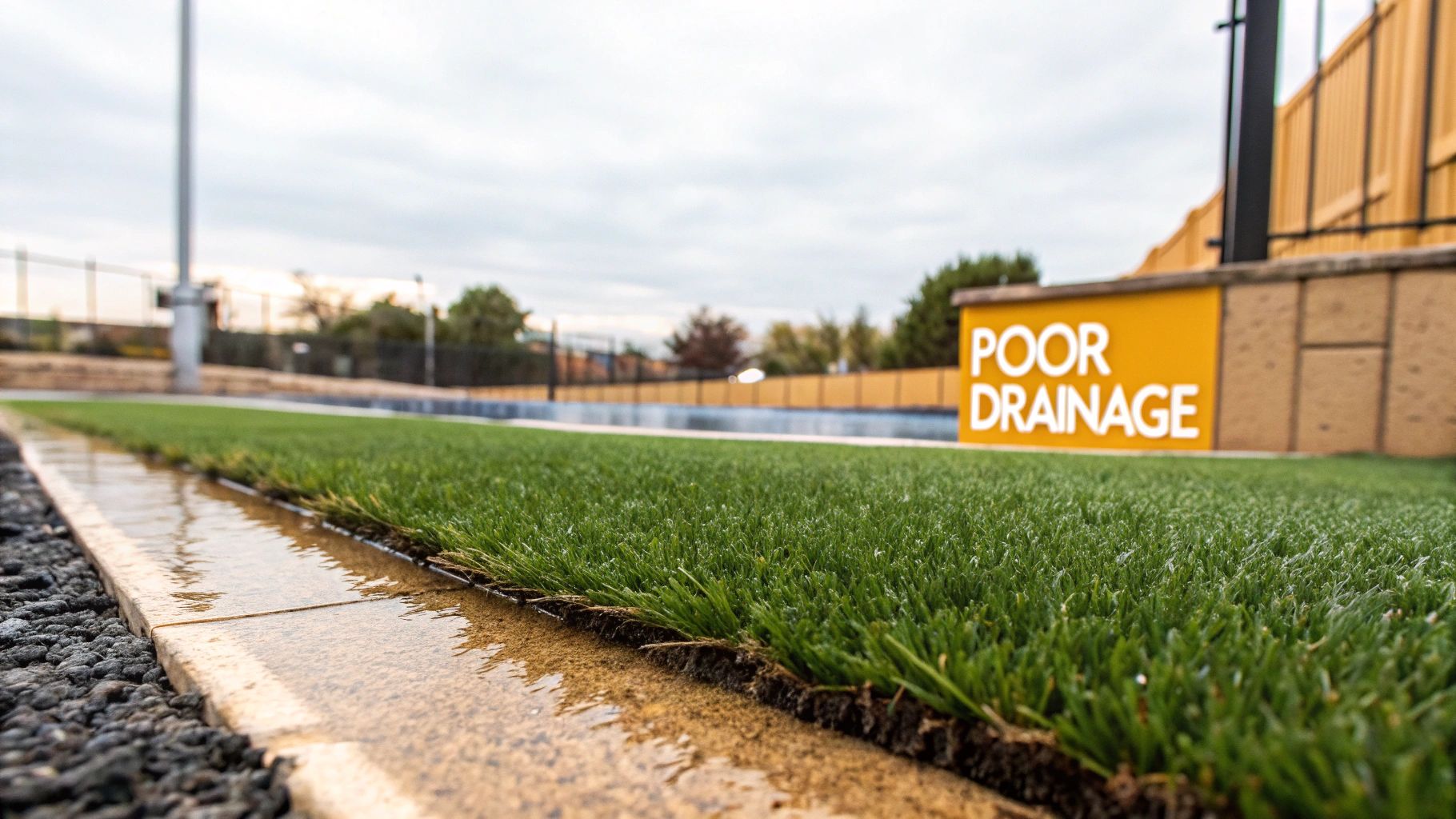
When you invest in artificial turf, you’re expecting a pristine, low-maintenance yard that can handle whatever our unpredictable South Texas weather throws at it. So, it's a real problem when you see standing water lingering for hours—or even days—after a downpour.
Those persistent puddles are more than just an eyesore. They can quickly lead to mold, musty odors, and a much shorter lifespan for your investment. Getting to the bottom of what's causing these artificial turf drainage problems is the only way to find a real, lasting solution. While a shoddy installation is the most common issue we see, a few different factors can turn your dream lawn into a waterlogged mess.
The Critical Role of the Sub-Base
Every successful artificial turf installation is built on a solid foundation, and that’s the sub-base. It's a carefully prepared layer of aggregate materials that sits directly under the turf. Here in places like Corpus Christi and San Antonio, where heavy clay soil is the norm, you can't just throw down a generic sub-base and call it a day. It just won't work. Clay soil is incredibly dense and doesn't let water pass through easily.
This is why a professionally engineered sub-base from a team like Fischer Landscaping is non-negotiable. We build a multi-layered foundation designed specifically to handle this challenge. The system allows water to pass through the turf backing, filter into the aggregate layers, and then safely disperse away from the surface. Without this crucial step, rainwater hits that compacted clay and stops dead in its tracks.
This foundational work also highlights why proper grading is so important to manage runoff. In fact, knowing how to prevent soil erosion is a critical part of the pre-installation process.
Quick Diagnosis of Common Drainage Issues
When you're faced with a soggy lawn, it helps to quickly narrow down the possibilities. This table can help you connect the symptoms you're seeing with the most probable cause.
| Symptom | Most Likely Cause | Initial Action |
|---|---|---|
| Widespread, uniform pooling across the entire lawn | Improperly prepared sub-base or compacted native soil | Inspect the turf edges to see the base layers; a professional assessment is likely needed. |
| Puddles forming in specific, isolated low spots | Improper grading beneath the turf | Use a level to check the slope of the affected areas; re-grading might be required. |
| Water drains very slowly everywhere, but eventually disappears | Compacted infill or clogged turf backing | Use a stiff-bristled broom to "bloom" or fluff up the turf fibers and loosen infill. |
Having a good idea of the root cause will save you time and help you focus on the right solution, whether it's a simple DIY fix or requires calling in an expert.
Other Common Drainage Culprits
While the sub-base is the usual suspect, a few other things can go wrong:
- Compacted Infill: Over time, heavy foot traffic can compact the sand or rubber granules between the turf blades. This creates a dense, non-porous layer that significantly slows down water flow.
- Improper Grading: The ground itself needs to be sloped correctly before any turf is laid down. If it's not, water will naturally find and collect in any low spots, creating permanent puddles.
- Clogged Turf Backing: Cheaper, lower-quality turf products often have fewer drainage holes. Worse, these small perforations can get clogged over the years with fine silt, dirt, and other debris, effectively sealing the surface.
A properly installed artificial turf system should drain faster and more efficiently than a natural grass lawn. If yours doesn't, the issue is almost certainly a failure in the system's design and installation, not the turf itself.
Diagnosing Your Turf Drainage Issues
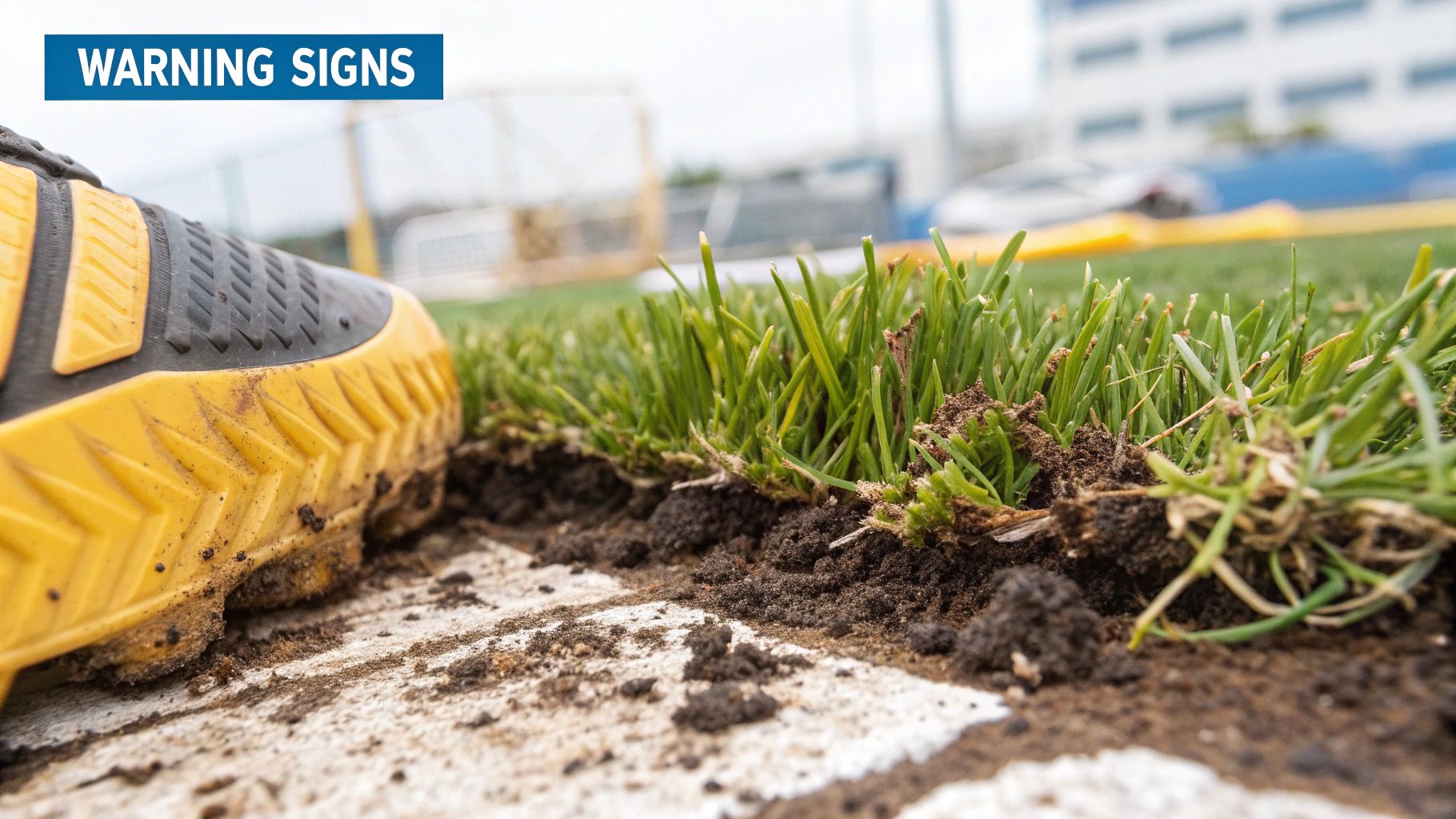
Before you can fix your artificial turf drainage problems, you have to play detective. The only way to find a permanent solution is to get your hands dirty and figure out exactly what’s causing the water to stick around. Is it a problem with the base? Compaction? Something else entirely? A little investigation will tell you everything you need to know.
A great starting point is the classic "flood test." It’s simple but incredibly revealing. Grab a garden hose and give one of the waterlogged areas a good, long soak for several minutes. The goal isn't just to get the turf wet; you're simulating a heavy downpour to see how the system responds under pressure.
Now, just watch. Where does the water go? Does it collect in one big puddle, or is the whole area just a swamp? Start a timer and see how long it takes to drain away. On a well-installed lawn, the water should disappear fairly quickly. If you’re still looking at standing water more than an hour later, you’ve officially confirmed a significant drainage problem.
Inspecting the Turf and Sub-Base
With the problem zones mapped out, it’s time for a closer look at the physical makeup of your lawn. A hands-on inspection can uncover clues that the flood test might have missed.
Start by checking the perimeter of your turf. If you can, gently lift a corner and peek underneath. You should see a clear, distinct layer of aggregate material—think crushed rock or decomposed granite. If all you see is dirt, or if that base layer looks thin and uneven, you've probably found a major reason your lawn isn't draining.
Next, take a walk across the entire turf surface and pay attention to what you feel. You can even probe the ground with a blunt object, like the end of a screwdriver handle. What you're looking for are spots that feel unusually hard or solid compared to the rest of the lawn. These are tell-tale signs of compaction, where the infill or the sub-base below has become so dense that water simply can't get through.
A homeowner in Corpus Christi might find a hidden layer of compacted clay just inches below the surface, while a business in San Antonio could discover their perimeter drain is clogged with silt. The symptoms can be similar, but the root cause is often unique to the site.
Identifying Common Culprits
By now, your investigation should be pointing toward one of the usual suspects. Combining what you saw during the flood test with what you felt underfoot helps build a clear picture of the underlying issue.
Here are the most common culprits we see in the field:
- Compacted Sub-Base: If you find large, unyielding patches, the aggregate base has likely been compressed over time, essentially creating an underground barrier that blocks water.
- Improper Grading: Water that always runs to the same low spot is a dead giveaway. This means the ground beneath the turf wasn't graded with the right slope during the initial installation.
- Clogged Perimeter Drains: If your property has a supplementary drainage system—common in areas like Brownsville or Harlingen—check the drain outlets. They can easily get blocked by leaves, silt, and other debris.
While this DIY diagnosis can solve many mysteries, some problems are buried too deep to spot without professional gear. If you’ve done your homework and are still stumped, or if all signs point to a major sub-base failure, it's time to bring in an expert. The team at Fischer Landscaping can perform a comprehensive assessment and lay out a clear plan to fix your drainage for good.
The Hidden Impact of Poor Turf Drainage
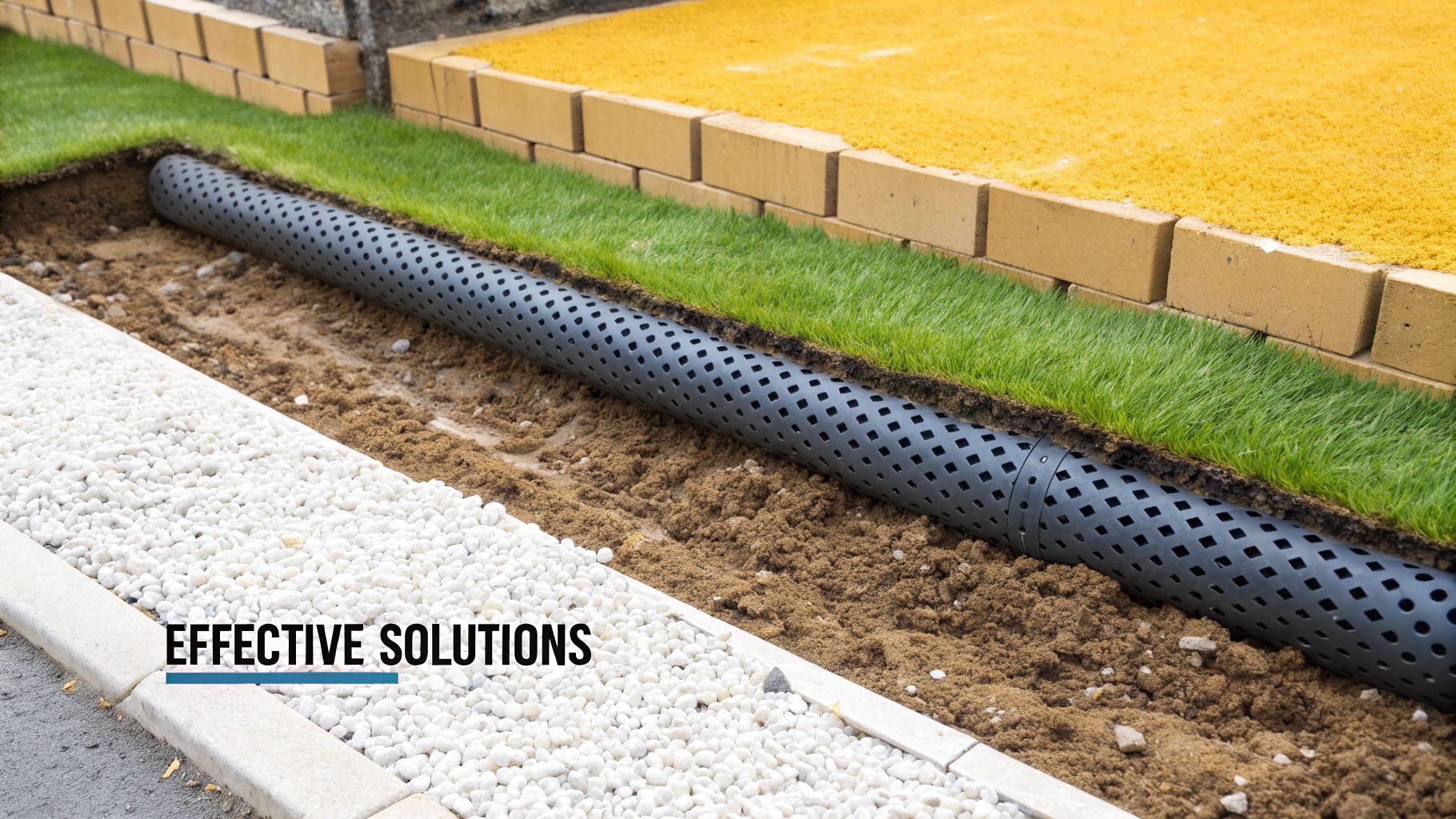
Those puddles lingering on your lawn long after a storm are more than just a nuisance. They're a red flag, signaling a serious breakdown in your landscape's drainage system—one with consequences that ripple out far beyond your property line, especially here in South Texas.
When artificial turf can't drain properly, the impact is often bigger than homeowners realize. Unlike a natural lawn where soil and deep roots absorb and filter rainwater, a poorly installed turf system can act a lot like a concrete slab. Water sheets off the surface, creating a surge of runoff that puts a real strain on municipal storm drains in places like Brownsville and Harlingen during our heavy downpours.
This rush of unfiltered water doesn't just disappear. It carries everything with it—debris, infill particles, and any residues sitting on the surface—straight into our local waterways.
Environmental and Health Concerns
The environmental fallout from artificial turf drainage problems is something we're taking more seriously. When water just runs off a surface without the chance to percolate through the ground, it bypasses the natural filtration that soil provides. That means contaminants get a free ride.
In fact, turf with a compacted, impermeable base can significantly increase localized flooding and overwhelm stormwater infrastructure. This rapid runoff can carry nutrients like nitrogen and phosphorus, along with chemicals such as zinc, lead, and cadmium from older turf components, directly into our soil and aquatic ecosystems. For a deeper dive, The Unbiased Science Podcast explores the environmental effects of turf runoff in great detail.
It's important to remember that the problem isn't the turf itself. It's the system—or lack thereof—underneath it.
A professionally designed drainage system is not just a practical upgrade—it's an environmentally responsible choice. It protects your investment while safeguarding the local ecosystem that makes South Texas unique.
Why Professional Design Matters
This is where a thoughtful, professional design makes all the difference. At Fischer Landscaping, we don’t just lay down turf; we engineer a complete water management solution tailored to the unique demands of your property.
Here’s a look at what goes into a properly designed system:
- Site-Specific Grading: It all starts with the grade. We ensure there’s a precise, subtle slope to guide water where it needs to go, preventing pooling and managing runoff from the start.
- Permeable Sub-Base Construction: We build a multi-layered aggregate base specifically designed for maximum permeability. This allows water to filter through naturally instead of sheeting off the top. This crucial foundation is a core part of our comprehensive hardscaping services.
- Integrated Drainage Solutions: For properties in Corpus Christi or San Antonio that deal with heavy water flow, we can integrate more advanced solutions like French drains to handle even the most intense rainfall.
Opting for a professional installation is an investment in a system that not only looks great but also functions as a responsible part of our local environment. Ready to make sure your turf project is built to last? Contact Fischer Landscaping to discuss your project.
Practical Fixes for an Already-Installed Turf
Once you've pinpointed what's causing your artificial turf drainage problems, you can start looking at real solutions. The right fix really depends on the severity of the issue—sometimes it’s a quick DIY job, while other times it calls for bringing in the pros. The most important thing is to match the solution to the root cause.
For minor pooling, especially where compacted infill from foot traffic is the culprit, aeration is often a fantastic starting point. It’s a process where we use special tools to gently create small holes through the turf and into the sub-base. This opens up little channels for air and water to get moving again. It's a lot like aerating a regular grass lawn and can work wonders for lawns in San Antonio that get a lot of use from kids and pets.
When You Need a More Serious Drainage System
If aeration doesn't cut it, or if you're dealing with a bigger problem like improper grading, it's time to consider a more robust system. One of the most effective ways we manage water on properties throughout South Texas is by installing a perimeter drain.
There are a couple of go-to options our clients usually choose between:
- Channel Drains: You've probably seen these. They're the surface-level grates that sit right at the edge of the turf, often next to a patio or walkway where water likes to gather. They're great for catching surface runoff right away.
- French Drains: This is a more hidden, below-the-surface approach. We lay a perforated pipe in a trench filled with gravel, usually along the lawn's edge. It quietly collects water that seeps down through the turf and sub-base, channeling it away from the area completely.
Getting these systems installed correctly is all about precision. A French drain, for example, needs the perfect slope to work—it's the same kind of careful planning that goes into projects where you learn how to build retaining walls to manage your yard's elevation and water flow.
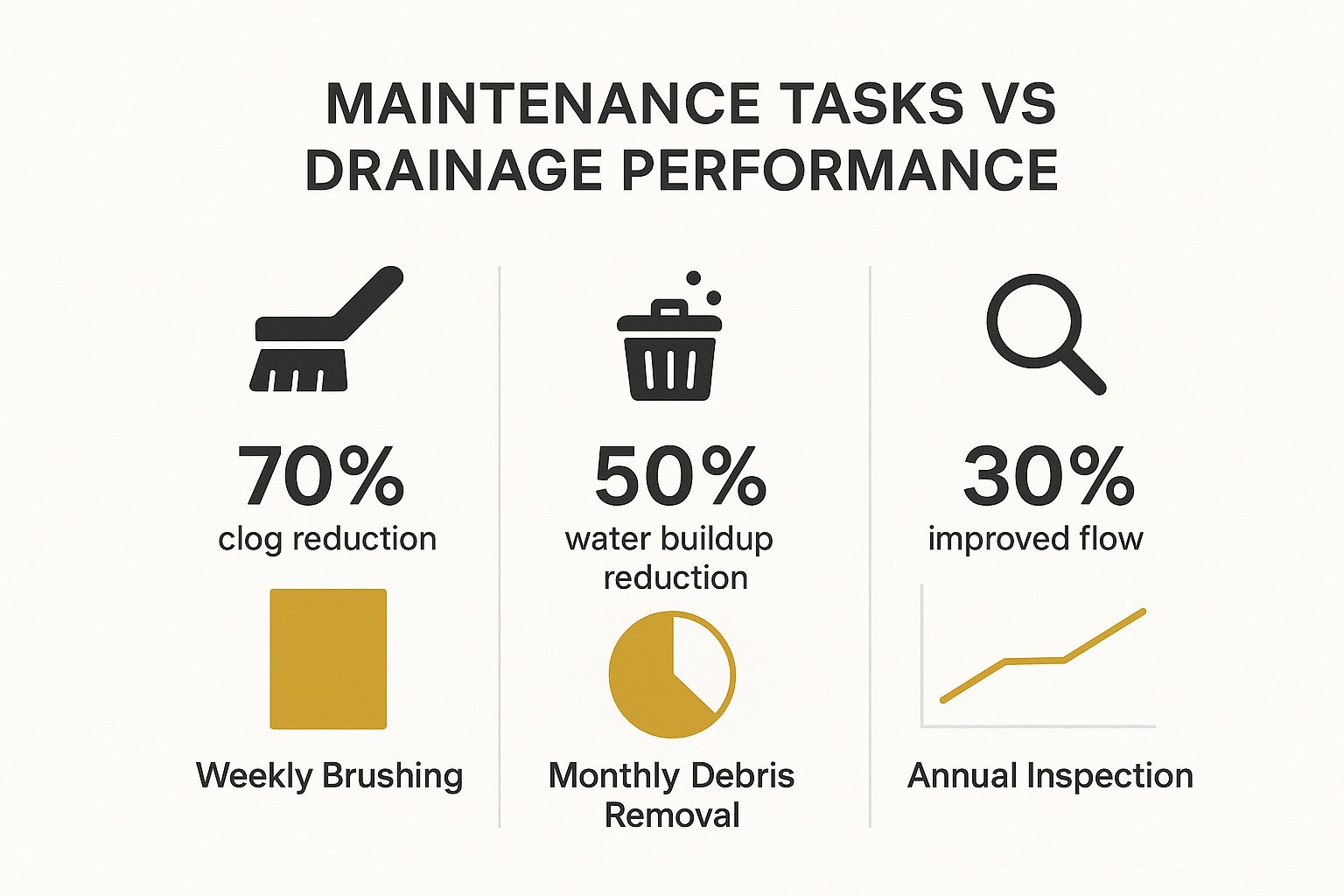
This image really drives home how much of a difference proactive maintenance can make. Just look at the impact of simple weekly brushing—it’s the single best thing you can do to stop infill compaction before it even starts. A little routine care goes a long way.
Comparing Drainage Solutions
To help you decide which path might be right for your situation, here's a quick comparison of the common solutions we've discussed.
| Solution | Best For | Typical Cost | Professional Help Needed? |
|---|---|---|---|
| Aeration | Minor compaction in high-traffic areas. | $ | DIY is possible, but pro tools are more effective. |
| Channel Drain | Capturing surface runoff along hardscapes like patios or driveways. | $$ | Usually, yes. Proper placement and connection are key. |
| French Drain | Widespread, subsurface drainage issues or yards with a gentle slope. | $$$ | Almost always. Requires excavation and precise sloping. |
| Sub-Base Rebuild | Complete drainage failure due to poor initial installation or heavy clay soil. | $$$$ | Absolutely. This is a complex, technical repair. |
As you can see, the solutions range from simple maintenance to major overhauls. Your choice will depend on both the problem and your budget.
Dealing with a Failed Sub-Base
So, what do you do when the problem is deep down, like a completely failed sub-base? This is something we see with older installations or ones that weren't built to handle the dense clay soil we have around Corpus Christi and Brownsville. When the foundation is bad, a surface fix just won't work for long.
When the foundation of your turf system has failed, a patch-up job is just a temporary fix. The only permanent solution is to rebuild the sub-base correctly from the ground up to ensure proper drainage for years to come.
This kind of repair takes real technical skill. Our teams at Fischer Landscaping have to carefully pull back the existing turf, dig out all the old, failed base material, and completely re-grade the ground underneath. Only then do we build a brand-new, multi-layered sub-base with the right kind of drainage aggregate before seaming the turf back into place perfectly.
It’s definitely a bigger project, but it’s a permanent one. Investing in a professional rebuild means the job gets done right the first time, saving you from recurring drainage headaches and protecting your artificial lawn for the long haul.
Preventing Drainage Problems from Day One
The best way to solve artificial turf drainage problems is to make sure they never happen in the first place. While you can always fix a waterlogged lawn, nothing beats the peace of mind that comes from a professional installation designed to handle water from the very beginning. It all comes down to what’s going on underneath those perfect green blades.
A truly high-performance drainage system isn't just an accident; it's engineered from the ground up, starting with a multi-layered aggregate base. This isn't just a simple layer of gravel. It's a calculated foundation built to channel water away effectively. For companies in this business, smart planning and expert execution are everything. It’s what separates a lawn that lasts from one that fails, which is why many connect with clients through resources like local SEO services for artificial turf installation to highlight their expertise.
Building a Foundation for South Texas Soil
Here in South Texas, from Corpus Christi all the way up to San Antonio, we have to contend with some seriously heavy clay soil. This stuff is dense, compacted, and the natural enemy of good drainage. If you just lay turf directly over it, you're practically begging for a swampy mess.
This is exactly why a custom-blended sub-base is non-negotiable for any Fischer Landscaping job. We use a specific, proven mix of crushed rock and decomposed granite to create a foundation that water can easily pass through. This multi-inch layer essentially acts as a giant French drain. It lets water move through the turf, filter down through the aggregate, and safely spread out away from your lawn, even during one of our notorious Texas downpours. Honestly, getting the sub-base right is the single most important thing we do to prevent drainage headaches down the road.
Peace of mind comes from knowing your artificial turf was installed correctly from the start. A professionally built sub-base is the unseen hero that guarantees a dry, usable lawn for years to come.
The Role of Quality Materials and Proactive Care
Beyond the foundation, every single component has a role to play in keeping your lawn dry. The turf itself needs a highly permeable backing with plenty of drainage holes. I've seen cheaper products that skimp on this, and it almost always leads to clogs and slow drainage over time.
The type of infill—that granular material we spread between the turf blades—is also critical. The right infill gives the turf stability and a nice cushion underfoot, but more importantly, it won't compact and turn into a solid barrier that blocks water.
Once the installation is complete, a few simple habits will keep the entire system working as intended.
- Regular Cross-Brushing: Grab a stiff-bristled broom and brush against the grain of the turf fibers every so often. This keeps the infill loose and stops it from getting compacted by foot traffic.
- Debris Removal: Make sure to clear off leaves, dirt, and other organic gunk. If you let it sit, it will break down and eventually clog up the turf’s backing and the infill layer.
This peek behind the curtain shows that a great turf installation is really a complete system. By focusing on a rock-solid foundation and using quality materials from the start, we build a lawn that's designed to last. For a more detailed look at the entire process, you can check out our guide on how to install artificial grass. When the job is done right from day one, you simply won't have to worry about drainage.
Common Questions About Turf Drainage
Over the years, working with homeowners from Corpus Christi all the way to San Antonio, we've tackled just about every turf drainage question you can imagine. Here are a few of the most common ones we hear, with some straight answers from our experience.
Can Pet Urine Really Clog My Turf's Drainage?
It's a valid concern, and the short answer is yes, it can. While the liquid from pet urine drains away just fine, it leaves behind uric acid crystals in the infill. Over time, these crystals build up.
This buildup acts like a magnet for dirt and debris, causing the infill to compact and clump. The result? Slower drainage and, eventually, that lingering ammonia smell. A simple, regular rinse-down with a hose and a good turf-safe enzyme cleaner is your best defense. It breaks down the crystals before they become a problem.
How Quickly Should My Artificial Turf Drain?
Your artificial turf should drain at a speed that makes natural grass look like it's standing still. A high-quality turf system, built on a properly prepared aggregate base, is an engineering marvel—it's designed to handle thousands of inches of water per hour.
What does that mean for your backyard? After a classic South Texas downpour, you shouldn’t see any significant standing water. If you still have puddles an hour after the rain has stopped, that's a red flag telling you something isn't right with the drainage underneath.
This is one of the biggest perks of artificial grass. Your lawn in Harlingen or Brownsville is ready for action almost as soon as the clouds part.
Can Weeds Grow Through the Turf and Mess Up the Drainage?
Even with a professional installation that includes a weed barrier, some stubborn weeds can occasionally push their way through, usually at the seams or right through the drainage holes. It's not just an eyesore; their root systems can disrupt the sub-base.
When roots spread, they can displace the base materials and trap debris, creating small, localized clogs. Keeping them in check is key.
- Be Proactive: A top-tier, durable weed barrier from the start is non-negotiable.
- Stay Vigilant: Pull any weeds the moment you spot them, before they can establish a foothold.
- Check the Edges: Periodically walk the perimeter of your turf and check the seams for any unwanted growth.
Getting ahead of weeds protects the drainage foundation you paid for. A well-maintained lawn is the best way to prevent weeds and the clogs they can cause. Integrating turf with a complete landscape plan, as we discuss in our guide to hardscaping solutions, is the best way to address these factors from the very beginning.
Don't let a drainage headache undermine your beautiful lawn. At Fischer Landscaping, we don't just lay turf; we engineer complete drainage systems designed specifically for the unpredictable South Texas weather. The goal is always a gorgeous, dry lawn that lasts.