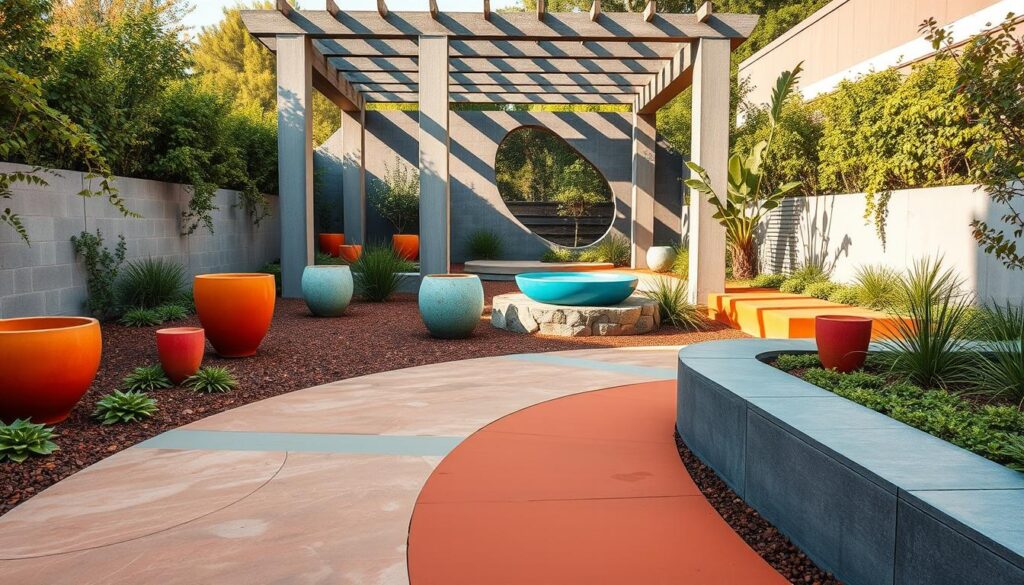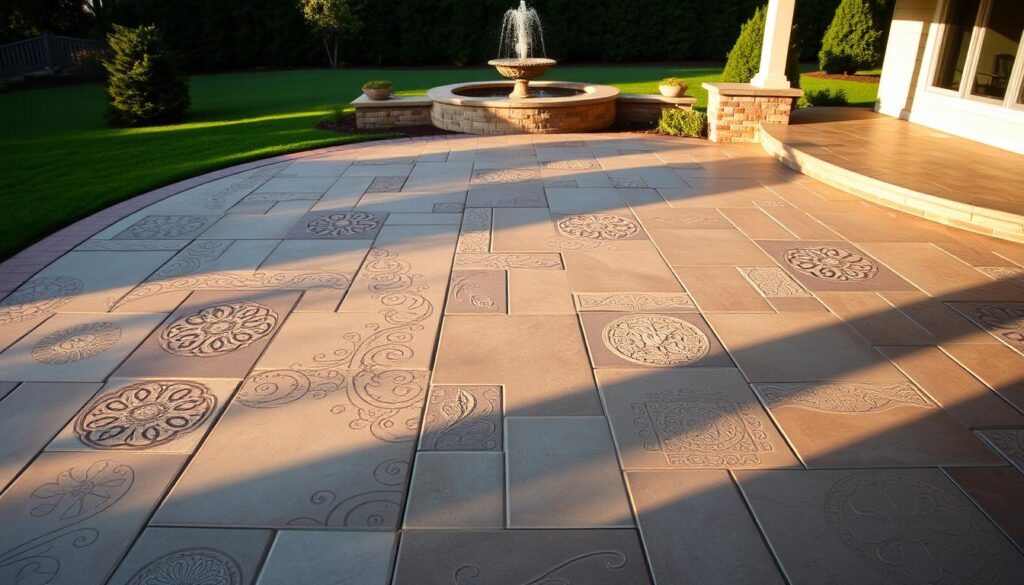
A successful garden doesn’t happen by accident. It’s the result of a thoughtful process that boils down to four key stages: site assessment, functional design, plant selection, and finally, creating a master plan. Following these steps is what ensures your garden will truly thrive in the unique South Texas climate, aligning your vision with the real-world conditions of your property.
Your Blueprint for a Thriving South Texas Garden
Anyone who's tried to garden in South Texas knows it's a different ballgame. A well-designed landscape here is far more than just a collection of pretty plants; it's a carefully crafted ecosystem built to withstand our intense heat, unpredictable downpours, and everything in between.
For homeowners and property managers from San Antonio down to Corpus Christi, the difference between a lush, beautiful landscape and a costly, sun-scorched failure often comes down to the quality of that initial plan. This guide provides an actionable framework for creating a garden layout that is both stunning and sustainable.
Why a Professional Plan Matters
Creating a functional outdoor space is a significant investment in your property's value and your quality of life. The growing emphasis on outdoor living has fueled a boom in the landscaping industry, with the North American garden design market valued at around $5 billion USD in 2024. You can find more insights on the landscaping market's growth and how it’s shaping modern design.
This growth signals that property owners recognize a strategic layout is the foundation for any long-term success. A professional plan helps you sidestep common, expensive pitfalls:
- Choosing plants that can't handle a Harlingen summer.
- Building a beautiful patio that floods after every rain.
- Underestimating how large a tree will grow, creating future problems.
- Failing to track the sun's path, leading to fried flowers and struggling shrubs.
A well-designed layout is the single most important factor in achieving a landscape that adds significant value to your property. It's the foundation upon which everything else is built.
Before diving into the specifics of your garden layout, a quick checklist can help organize your thoughts and ensure you're starting on the right foot.
South Texas Garden Planning Checklist
This table breaks down the essential first steps for planning any successful garden layout in our unique climate.
| Planning Phase | Key Action | Why It's Critical for South Texas |
|---|---|---|
| Site Assessment | Map sun exposure, drainage, and existing features. | Intense sun and flash floods are non-negotiable realities you must plan for. |
| Functional Design | Define how you'll use the space (e.g., entertaining, relaxing, play). | This dictates the placement of patios and walkways to maximize usability. |
| Budgeting | Set a realistic budget for plants, materials, and potential labor. | Prevents overspending and ensures you can complete the project without compromises. |
| Lifestyle Check | Honestly assess how much maintenance you are willing to do. | Low-maintenance native plants are often a better choice for busy property owners. |
This checklist covers the core decisions that will guide the rest of your design process effectively.
Building Your Foundation for Success
The goal of this guide is to help you translate your vision into a practical, workable plan. Whether you're considering a new hardscape installation to create a perfect patio, a vibrant native plant garden, or a complete landscape overhaul, the principles of good planning remain the same.
Thinking through your layout systematically forces you to consider critical variables: sunlight, soil type, water use, and your own lifestyle. Proper planning saves an incredible amount of time, money, and frustration. For larger properties or commercial sites, our commercial landscaping team specializes in creating detailed, sustainable master plans from the ground up.
Ready to turn your ideas into a professional, actionable plan? The team at Fischer Landscaping can help you design a garden layout that perfectly suits your property and lifestyle. Contact us today to request a quote.
Conducting a Professional Site Assessment
Before buying plants or digging a single hole, every great landscape design starts with a thorough site assessment. This isn't a casual stroll around your yard; it's a critical analysis that lays the groundwork for a successful garden, saving you from costly mistakes. It's the first thing our professional team does on every project, whether in Corpus Christi, Harlingen, or anywhere in between.
This initial analysis is your project's roadmap. By mapping out your property's unique characteristics, you ensure your design works with our local climate, not against it. It’s all about making smart, informed decisions right from the start.
Mapping Sun Exposure and Shade Zones
In South Texas, the sun is a force to be reckoned with. It's the single biggest factor dictating what will thrive and what will struggle. To do this right, you need to track the sun's path across your property for a full day.
Spend a day observing and sketching your yard—morning, midday, and late afternoon. Note which areas get direct sunlight for more than six hours (full sun), which get between three and six hours (part shade), and which stay mostly covered (deep shade). This simple map is a powerful tool for placing plants correctly.
Understanding Your Soil Composition
Your soil is the lifeblood of your garden. Here in South Texas, soils can range from heavy clay to loose sand. Knowing what you’re working with is non-negotiable for healthy plants. A simple soil test reveals if you have:
- Clay Soil: Heavy and holds moisture, but can become compacted, leading to poor drainage.
- Sandy Soil: Drains too well, often struggling to hold the water and nutrients plants need.
- Loam Soil: The ideal mix of sand, silt, and clay that offers excellent drainage and nutrient retention.
A soil test guides everything from plant selection to watering schedules. If your soil needs help, our expert advice on how to prepare soil for planting provides the best foundation for your new layout.
Identifying Microclimates and Existing Features
Every property has microclimates—small pockets where conditions differ from the rest of the yard. For instance, the ground next to a west-facing brick wall in San Antonio will be much hotter than a shaded corner under a live oak.
It's crucial to document these unique zones and all permanent fixtures on your property, including:
- Mature trees and large shrubs
- Patios, decks, and walkways
- Utility lines, septic systems, and downspouts
- Any spots with obvious drainage issues
This creates a visual inventory of what you have to work with before you start designing.
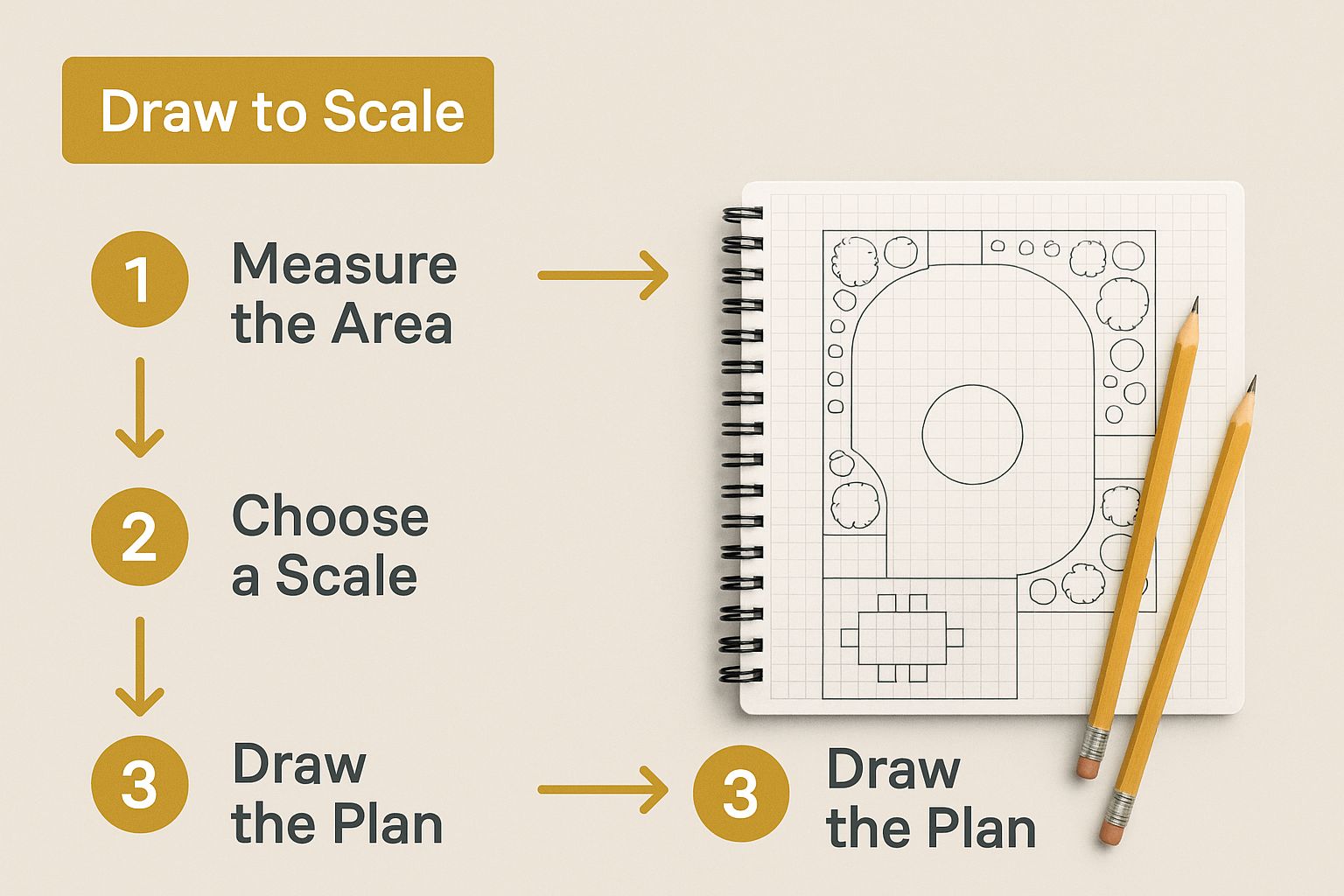
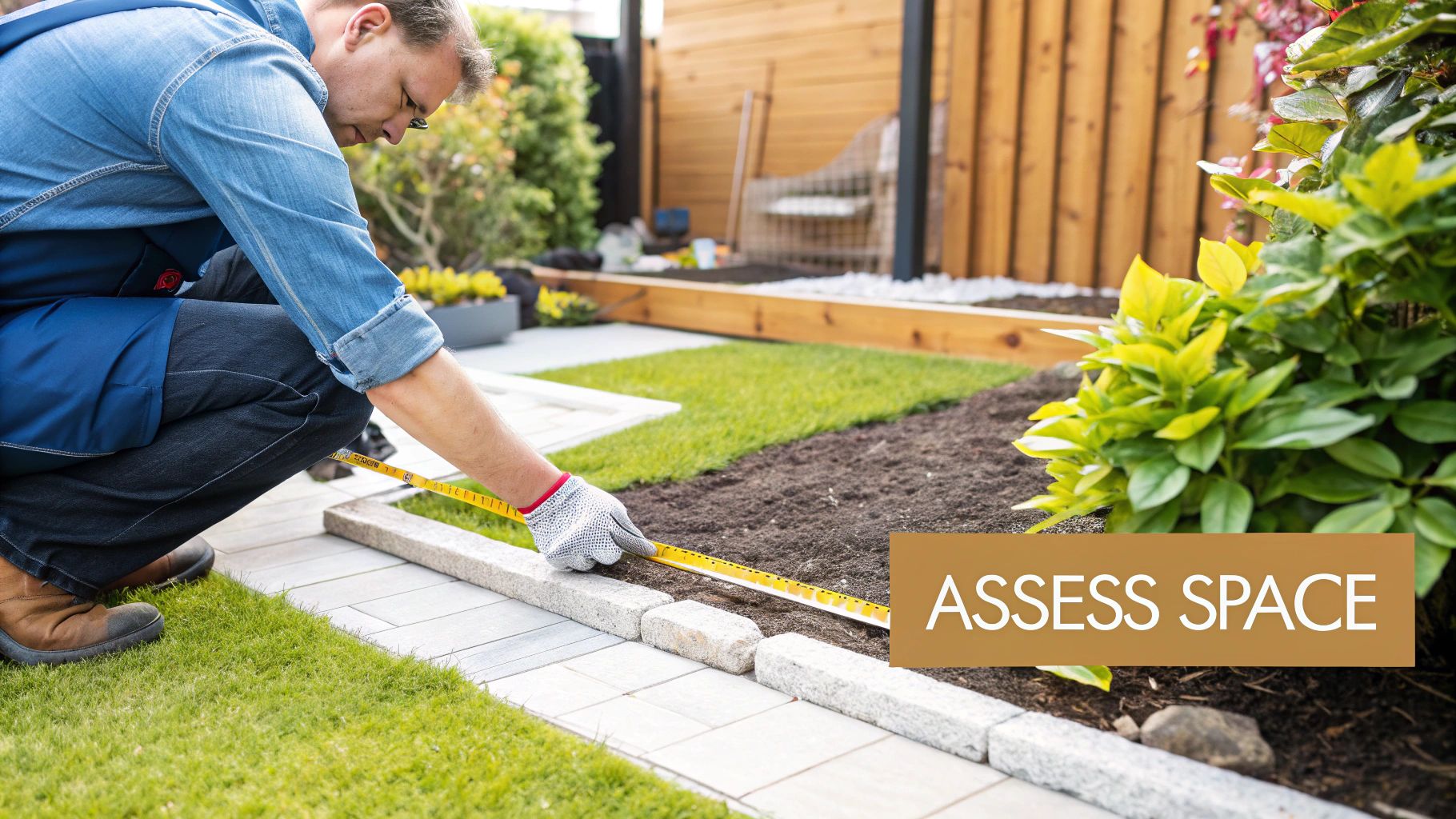
As you can see, a detailed, to-scale sketch of your property is essential during this assessment. A precise drawing helps you accurately map everything from sun patterns to existing structures, forming the true foundation of your garden plan.
This detailed site assessment is the most critical step in the planning process. It moves your project from guesswork to a strategic, data-driven approach, ensuring the final layout is beautiful and sustainable.
Putting together a comprehensive site analysis can feel overwhelming, but the value it provides is immense. If you want to ensure your garden plan is built on solid ground, the experts at Fischer Landscaping can handle the professional site assessment for you.
Designing a Functional Layout for Your Lifestyle
With a solid understanding of your site, you can shift from analysis to creative design. This stage is about defining how you’ll use the space. A beautiful garden that doesn’t fit your lifestyle can quickly become a chore.
A simple yet powerful technique is the "bubble diagram." This is a rough sketch of your property where you draw circles—or "bubbles"—to represent different activity zones, helping you think through what you want from your outdoor space.
Mapping Out Your Activity Zones
Before putting pencil to paper, consider how you and your family spend time outdoors. Are you big on entertaining, or do you crave a quiet corner for coffee? Your answers will directly shape your layout.
Common zones for South Texas homes often include:
- An Outdoor Dining Area: Best located near the back door for easy access to the kitchen.
- A Relaxation Zone: A quiet corner positioned to catch a nice evening breeze.
- A Play Space: An open, durable area for kids and pets, often with a soft surface like grass.
- A Utility Area: A discreet spot for trash cans, a compost bin, or a tool shed.
Sketching these bubbles on your site map helps you see how different areas relate to each other and your home, leading to smarter design decisions.
Before you finalize your activity zones, see how different areas can serve various purposes. The right layout balances your needs, whether you're hosting a party or seeking a quiet escape.
Layout Zone Planning Guide
| Garden Zone | Primary Use | Ideal Location | Key Hardscape and Plant Considerations |
|---|---|---|---|
| Entertainment & Dining | Hosting guests, outdoor meals | Close to the kitchen; easily accessible from the house. | Patios, decks, outdoor kitchens, ambient lighting. Use container plants for color without clutter. |
| Relaxation & Contemplation | Reading, meditation, quiet time | A secluded corner, away from high-traffic areas. | Comfortable seating, water features, privacy screens or hedges, fragrant plants. |
| Family & Play | Children's activities, pets | Open, level ground with good visibility from the house. | Durable lawn, non-toxic plants, soft mulch, secure fencing. |
| Utility & Storage | Hiding tools, trash bins | Side yard or a screened-off back corner. | Sheds, solid fencing, gravel or pavers for a clean surface. Minimal planting needed. |
Thinking in terms of zones ensures every square foot of your garden has a purpose that fits your life.
Creating Flow with Pathways and Circulation
Once you’ve blocked out your zones, consider how people will move through the garden. Well-designed pathways guide you naturally from one spot to another. The flow should feel intuitive.
Your pathways are a core design element. A gently curving flagstone path creates a relaxed, organic feel, while a straight paver walkway lends formality. A main path should be wide enough for two people to walk side-by-side, typically around four to five feet.
A garden's layout should feel like a natural extension of your home. The flow between different garden zones and overall usability are just as important as the aesthetic appeal.
Strategically Placing Hardscape Elements
With zones and pathways mapped, you can now pinpoint where to place major hardscape elements—the patios, walkways, retaining walls, and fences that provide structure.
Getting placement right is crucial. A patio's location should be guided by your sun exposure map. A spot that gets blasted by the full afternoon sun in Brownsville might be unbearable in July. If you're planning for a clear boundary, looking into durable fence panel options can help define your space effectively.
This is where professional experience makes a difference. At Fischer Landscaping, we ensure every patio is graded for drainage and every walkway is built on a solid foundation, preventing future problems. A functional layout also considers practical needs, like irrigation, from the start. Planning for water access now saves you from tearing up your landscape later. Our guide on how to install drip irrigation systems is a great resource to review as you finalize your zones.
Selecting Resilient Plants and Materials
Now it’s time to choose the plants and materials that bring your garden to life. For a South Texas garden, beauty must go hand-in-hand with resilience. The secret to a lasting landscape is making smart choices that can handle our demanding climate.
It all comes down to "right plant, right place." Your site assessment gave you a map of your yard's sun and shade patterns; now you can use that knowledge to pick plants that will thrive with minimal fuss. For anyone landscaping from San Antonio to Brownsville, this means embracing plants that love the heat and don’t mind drought.
Choosing Plants for the South Texas Climate
The most successful and low-maintenance gardens in our region are built around native or well-adapted plants. These varieties are wired to handle our intense sun and unpredictable rainfall, which means lower water bills and less weekend work for you.
When picking plants, think in layers to create depth and visual interest. A good mix includes:
- Evergreens: These are the "bones" of your garden, providing year-round structure and color. Consider Texas Sage, Yaupon Holly, or certain agaves.
- Perennials: Returning year after year, these plants deliver seasonal color. Local favorites like Black-eyed Susans, Lantana, and Salvias are fantastic choices that attract pollinators.
- Ornamental Grasses: To add texture and movement, nothing beats ornamental grasses. Varieties like Gulf Muhly or Little Bluestem bring a soft, natural feel and are exceptionally tough.
This layered strategy ensures your garden looks great year-round. For a deeper dive, check out our guide on the best native plants of South Texas. It's also smart to think about pest prevention. An Integrated Pest Management (IPM) approach helps create a garden that naturally keeps pests at bay.
Selecting Durable Hardscape Materials
Just like plants, your hardscape materials must be suited for the South Texas environment. The right materials will match your home's aesthetic and stand up to UV rays and temperature swings without cracking or fading.
Choosing the right hardscape materials is a long-term investment. Factoring in heat absorption, durability, and maintenance from the start will prevent costly replacements and ensure your patios and walkways remain beautiful and functional for years.
Here are a few popular hardscape choices in our area:
| Material | Key Characteristics |
|---|---|
| Flagstone | Offers a natural, rustic look. It's incredibly durable, but darker colors can get scorching hot under the summer sun. |
| Pavers | Available in a huge range of styles, concrete pavers offer great design flexibility and handle our shifting soils well. Lighter colors are a smart choice to keep surface temperatures down. |
| Decomposed Granite (DG) | An affordable choice for pathways and secondary patios. It provides a soft, natural look and excellent drainage but may need a top-up every few years. |
This is where professional advice can save you from an expensive mistake. The team at Fischer Landscaping has years of experience selecting and installing materials perfectly suited for the Corpus Christi climate, ensuring your hardscapes look amazing for years to come.
Putting It All Together: Your Final Master Plan
You’ve assessed your property, sketched your zones, and picked your plants and materials. Now it's time to pull everything together into a cohesive master plan. This is the detailed blueprint that will turn your vision into a living, breathing garden.
A great plan is about how every element—from the curve of a path to the color of a flower—works together to create a unified, beautiful space.
Weaving in Key Design Principles
To give your plan a professional polish, focus on a few core design principles:
- Establish Focal Points: Every good design needs a star. A focal point grabs your attention, like a sculptural tree, a water feature, or a shade pergola that offers a welcome escape from the sun.
- Create Rhythm with Repetition: Repeating plants, colors, or materials creates unity. Using the same flagstone for your patio and garden path ties the hardscape elements together.
- Layer for Depth and Interest: Think in layers. Place taller shrubs at the back of garden beds, fill the middle with medium-sized perennials, and line the front with low-growing groundcovers. This adds depth and makes the garden feel larger.
When you start thinking this way, your plan becomes more than just functional—it becomes a work of art.
From Rough Sketch to a To-Scale Drawing
It's time to get precise. Grab graph paper and translate your design into a scale drawing, such as 1/4 inch = 1 foot. This non-negotiable step ensures everything will fit when you start digging.
Your master plan needs to be specific. Don't just jot down "shrub"; note its exact name and quantity, like "3 x Texas Sage (Leucophyllum frutescens)."
Your final drawing should clearly label:
- Specific plant names, quantities, and their exact placement.
- Correct spacing for each plant based on its mature size.
- All hardscape elements, with dimensions and materials (e.g., "12'x15' Paver Patio").
- The layout for essential infrastructure like your landscape lighting and irrigation system.
A detailed, to-scale master plan is your project's single source of truth. It eliminates guesswork, helps you accurately calculate costs, and ensures the final result matches your vision precisely.
The Value of a Professional Set of Eyes
You've done an amazing job getting this far, but this is the perfect moment for a professional review. The experts at Fischer Landscaping can look over your master plan with a trained eye. We often spot potential issues that are easy to miss, like improper plant spacing for our climate or a drainage problem a new patio might create.
We can help refine your ideas, confirm your choices will thrive locally, and map out a phased installation plan that works with your budget. Our specialty is turning a property owner's dream garden into a beautiful, functional, and lasting reality.
Ready to put the final touches on your plan? Contact Fischer Landscaping today for a professional consultation and quote.
Common Questions About Garden Layout Planning
Even the most carefully considered plans spark questions. Drawing from our experience helping homeowners and businesses from San Antonio down to Brownsville, we've compiled answers to the questions we hear most often.
What Are the Most Common Mistakes to Avoid?
The single biggest mistake we see is underestimating how big plants will get. That one-gallon shrub looks perfect today, but in a few years, it might swallow your walkway. Always plan for the mature size. Another common pitfall is not thinking about flow. A garden without clear, intuitive paths feels confusing. Finally, choosing plants for looks alone, without considering your property's challenges—like the relentless afternoon sun we get in Harlingen—is a surefire way to end up with struggling plants.
How Can I Make My Garden Layout Low Maintenance?
For a low-maintenance garden in South Texas, smart planning is everything.
- Choose Native Plants: Start by choosing native and well-adapted species that are naturally drought-tolerant. This dramatically cuts down on watering and care.
- Group Plants Wisely: Put plants with similar water needs together. This is called hydrozoning, and it makes your irrigation incredibly efficient.
- Incorporate Hardscaping: Patios, walkways, and seating areas reduce the amount of lawn you have to maintain.
- Use Mulch: A thick, 2-3 inch layer of mulch in garden beds keeps weeds down, holds moisture in the soil, and keeps roots cool.
A low-maintenance landscape isn’t about neglect; it’s about making strategic upfront choices that minimize your long-term workload.
Should I Plan for Irrigation and Lighting in the Initial Layout?
Yes, absolutely. Thinking about irrigation and lighting from day one is far more efficient and less expensive than trying to add these systems later. When you plan irrigation zones from the start, you ensure every section gets the water it needs without waste—crucial for water conservation in the Coastal Bend. The same goes for landscape lighting. Planning ahead allows you to run wiring exactly where it needs to go to light pathways and accent features for a seamless, functional, and stunning garden.
Planning a garden layout is a deeply rewarding journey. Getting professional guidance ensures you get it right the first time. The experienced team at Fischer Landscaping can help you sidestep common pitfalls and create a sustainable, beautiful landscape that will flourish in South Texas.