Before you put a single plant in the ground, the real work for a stunning South Texas landscape begins with the soil. Proper soil preparation is the most critical step for a successful garden or commercial landscape, ensuring your investment thrives for years to come. It’s a straightforward process: test your soil to understand its composition, amend it to improve its structure, and condition it to create the perfect environment for roots to flourish.
Getting this foundation right is easily the most important step for a successful garden or landscape.
Building the Foundation for a Healthy Landscape
Here in South Texas, our native soils present unique challenges for homeowners and property managers alike. We often deal with one of two extremes: dense, heavy clay that becomes waterlogged after a rainstorm, or sandy soil that drains so quickly plants can’t absorb moisture.
Combine these conditions with our intense summer heat, and it becomes clear why simply digging a hole and planting is a recipe for failure. A thriving landscape demands a smarter, more professional approach—one focused on transforming challenging ground into a rich, fertile foundation. This is precisely where expert Landscape Design & Installation services provide immense value, starting quite literally from the ground up.
Why You Can’t Afford to Skip Soil Prep
Attempting to landscape without preparing the soil is like building a house on a shaky foundation. It may look acceptable for a short time, but problems are inevitable. A professionally prepared garden bed provides plants with everything they need to flourish, saving you time, money, and frustration down the line.
- Better Water Retention: Amending the soil helps it act like a sponge, holding moisture longer. This is a game-changer for surviving the dry spells we experience in places like Harlingen and Brownsville.
- Improved Drainage: For properties with heavy clay, adding organic matter creates channels for excess water to escape, preventing the root rot that often follows a downpour.
- Easier Nutrient Access: Healthy soil is full of air pockets that allow roots to easily access the nutrients they need to grow strong and resist disease.
- Deeper, Stronger Roots: Plants in loose, well-structured soil can send their roots deep, making them far more resilient to drought and other environmental stresses.
The single most impactful action for any property owner is to improve soil health. It is the backbone of a flourishing landscape, directly affecting everything from plant vitality to long-term maintenance costs.
Ultimately, investing time and resources in proper soil preparation yields significant returns season after season. You’ll enjoy healthier, more vibrant plants that require less water and fewer fertilizers, reducing overall maintenance needs.
Core Stages of Soil Preparation
This table outlines the essential steps our team at Fischer Landscaping takes to transform your ground into a fertile base, ensuring your South Texas landscape is set up for long-term success.
| Stage | Primary Goal | Key Benefit for Your Landscape |
|---|---|---|
| Soil Testing | To understand the soil’s pH and nutrient composition. | Identifies specific deficiencies so you can add exactly what’s needed, not just guess. |
| Soil Amending | To improve soil structure, drainage, and water retention. | Creates a balanced environment that supports strong root growth in both clay and sandy soils. |
| Soil Conditioning | To incorporate amendments and create a uniform planting bed. | Ensures a loose, consistent texture that makes it easy for roots to establish and grow deep. |
Each stage builds upon the last, creating a cumulative effect that results in a truly resilient and low-maintenance landscape.
This guide will walk you through these crucial steps, providing practical knowledge to prepare your soil for the unique demands of our South Texas climate. For a comprehensive, long-term strategy, our Landscape Maintenance programs are designed to continually enhance and protect your soil’s vitality over time.
Figuring Out What’s Happening Under Your Feet
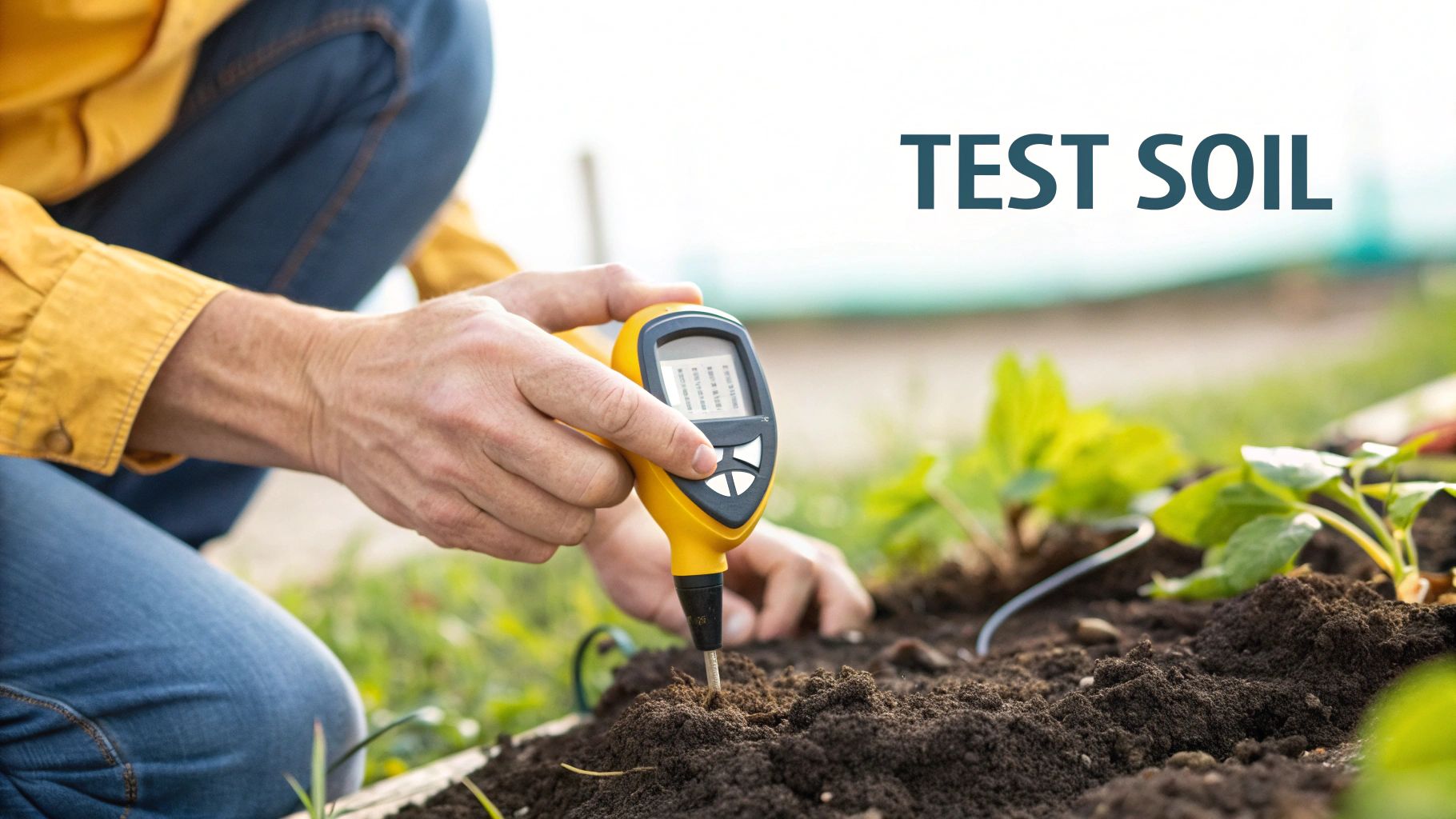
Before any planting occurs, you must understand your soil. Trying to “fix” your soil without a proper diagnosis is a shot in the dark—a surefire way to waste time, money, and effort on amendments that may not address the root problem. This initial step is everything.
You can learn a great deal with a few simple, hands-on tests. Getting a feel for your soil’s texture is the perfect place to start. A quick “jar test” is an old-school trick that still works wonders.
Getting a Feel for Your Soil’s Texture
Grab a clear jar, fill it about halfway with soil from your garden, and top it off with water, leaving some room at the top. Shake it vigorously for a minute, then let it settle for a full 24 hours.
Distinct layers will form. Heavy sand particles sink first, followed by finer silt, and finally, a layer of the finest clay particles on top. This simple visual provides a surprisingly accurate idea of your soil’s composition. It will immediately tell you if you’re dealing with poor drainage (too much clay) or if your soil dries out too quickly (too much sand)—common challenges from Corpus Christi all the way to San Antonio.
But a jar test only reveals part of the picture. The invisible factors, like your soil’s pH level, are just as critical.
A professional soil test is the single best investment you can make for your landscape. It’s like getting a detailed, scientific blueprint of your soil’s nutrient levels and pH. It takes all the guesswork out of the equation.
Why You Can’t Skip a Professional Soil Test
Here in South Texas, we often deal with alkaline soil, which has a high pH. This is a significant issue because high alkalinity can “lock up” vital nutrients like iron, preventing plants from absorbing them.
Ever seen plants with yellowing leaves? That’s often a condition called chlorosis. Your first instinct might be to add fertilizer, but if the pH is off, the plants still can’t access the nutrients. A professional soil analysis from a local extension office or a private lab provides the hard data needed to address the actual problem.
To get an accurate reading, collect a composite sample. Dig down about 6-8 inches in several different places within the planting area and mix the soil together in a clean bucket.
Want a deeper dive into what makes our local ground so unique? Check out our guide on the secret to healthy soil in commercial landscaping.
This proactive approach is more than just good landscaping; it’s responsible land stewardship. Fertile topsoil is disappearing at an alarming rate worldwide. Projections show that 95% of Earth’s land could be degraded by 2050 if current practices continue. As highlighted by Earth.org, understanding and improving your own soil is a small but vital part of the solution.
Once you have those test results, you have a clear roadmap. No more guessing. You can confidently choose the exact amendments needed to create the perfect foundation for healthy, thriving plants. If poring over lab reports and sourcing materials sounds like a headache, the experts at Fischer Landscaping are here to help. Contact us today for a quote and let us build the perfect soil foundation for your landscape.
Choosing The Right Soil Amendments
With your soil test results in hand, you have a diagnosis. Now it’s time to actively improve your soil’s structure and fertility. This is where the real work of soil preparation begins, turning tough South Texas ground into a high-performance growing medium.
The amendments you need depend entirely on your soil type. A property in San Antonio with heavy, compacted clay requires a completely different strategy than a coastal landscape in Corpus Christi dealing with loose, sandy soil. Getting this step right is absolutely crucial for long-term success.
Amendments For Heavy Clay Soil
If you’re battling the dense, sticky clay common in our region, your main goals are to improve drainage and aeration. Clay particles are tiny and pack together tightly, squeezing out air and trapping water—a recipe for root rot.
To break up this compaction, you need to introduce materials that create space.
- Expanded Shale: This is a game-changer for clay soil. It’s a lightweight, porous aggregate that creates permanent air pockets and improves drainage without breaking down over time.
- Compost: High-quality, well-rotted compost is the universal soil improver. For clay, it works by binding tiny particles into larger clumps (a process called aggregation), which dramatically improves structure and allows water to flow freely.
- Aged Pine Bark Fines: These small pieces of bark also excel at creating air pockets and lightening the overall texture of heavy soil.
Amendments For Sandy Soil
On the flip side, sandy soil presents the opposite problem. Its large particles allow water and nutrients to wash straight through, a significant issue during our hot, dry summers. Here, the focus is on boosting water and nutrient retention.
The best tools for sandy conditions are:
- Peat Moss: A classic for a reason, peat moss can hold a massive amount of water, releasing it slowly to plant roots as needed.
- Compost: Once again, compost is key. It adds rich organic matter that acts like a sponge, significantly improving the soil’s ability to hold onto both moisture and essential nutrients.
- Coconut Coir: Similar to peat moss, coir is fantastic for water retention and adds much-needed structure to overly loose, sandy soil.
This image shows how different organic amendments contribute different primary nutrients.
As you can see, something like compost provides balanced, low-level nutrients, while bone meal offers a big hit of a specific nutrient like phosphorus. It’s all about knowing what your soil is missing.
Remember, the goal isn’t to replace your native soil—it’s to enhance it. Mixing the right amendments into your existing soil creates a balanced, resilient foundation that will support deep, healthy roots for years to come.
Common Soil Amendments for South Texas Gardens
Choosing the right amendment can feel overwhelming. To make it easier, here’s a quick reference table based on our years of experience working with local soils.
| Amendment | Best for Soil Type | Primary Benefit | Application Notes |
|---|---|---|---|
| Compost | Universal (Clay & Sand) | Improves structure, adds nutrients | The all-star. Use high-quality, fully decomposed compost. |
| Expanded Shale | Heavy Clay | Permanent aeration & drainage | Mix thoroughly into the top 6-8 inches. One-time application. |
| Peat Moss | Sandy | Moisture retention | Best for acid-loving plants. Mix well; can be hydrophobic if dry. |
| Aged Pine Bark | Heavy Clay | Improves aeration & structure | Finer particles work best. Breaks down slowly over time. |
| Coconut Coir | Sandy | Water retention, neutral pH | A sustainable alternative to peat moss. Great for all plant types. |
| Greensand | All types | Adds potassium & micronutrients | A slow-release source of minerals. Good for overall soil health. |
This table is an excellent starting point, but every property is unique. The key is to blend these materials to create a custom mix that addresses your specific challenges.
Understanding amendments is one thing, but pairing them with the right plants is another. Learn more in our guide on how to choose the right plants for your soil type. Sourcing, measuring, and properly mixing these materials is a big job. The Fischer Landscaping team has the expertise and equipment to ensure the correct amendments are blended in the perfect ratios for your property, taking the guesswork and heavy lifting off your plate.
Effective Tilling and Mixing Techniques
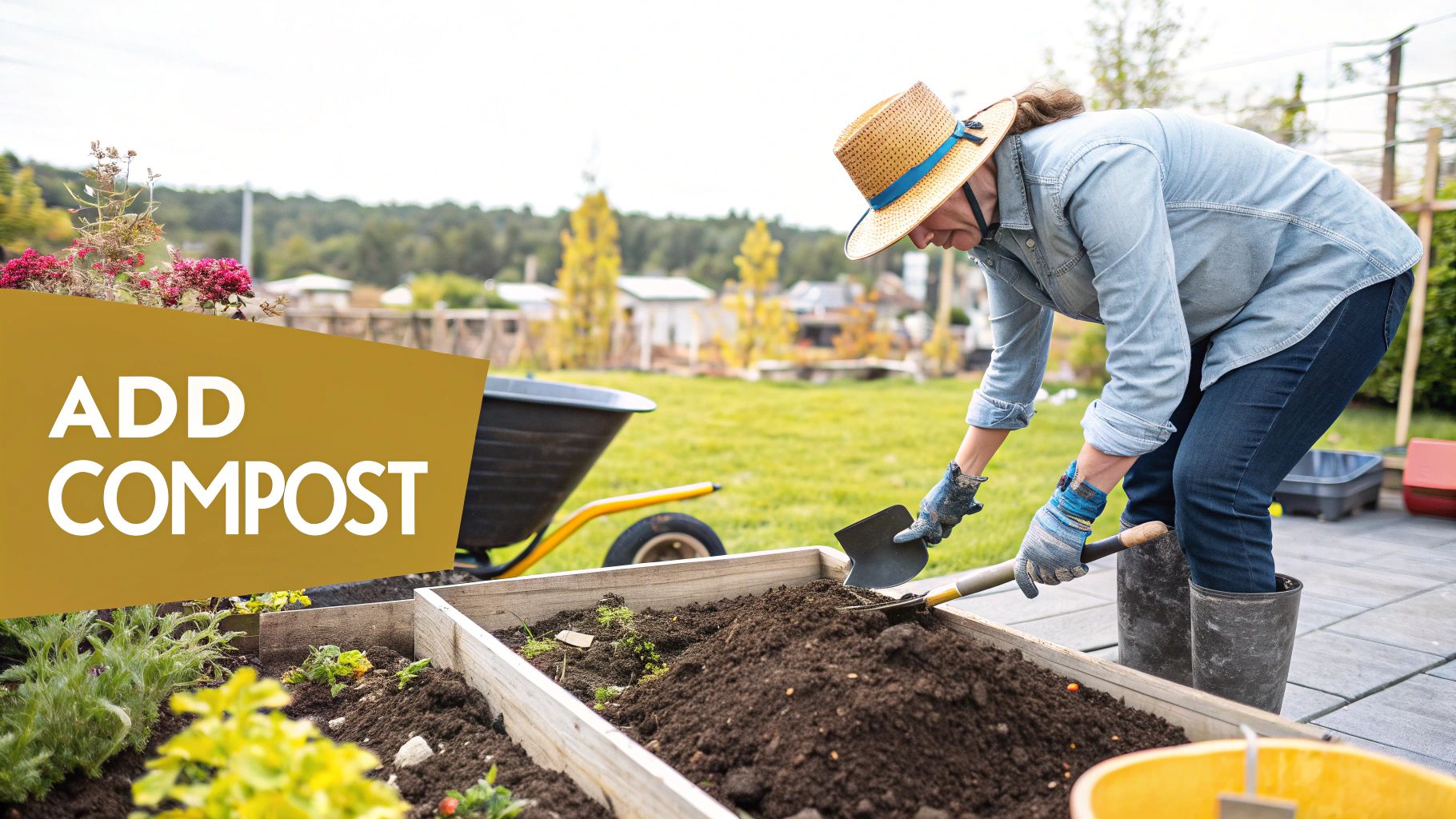
A common mistake homeowners make is simply scattering amendments over their garden bed. To truly transform your soil, you must fully and evenly incorporate these valuable materials. This is the only way to guarantee plant roots have consistent access to the nutrients, air, and water they need to thrive.
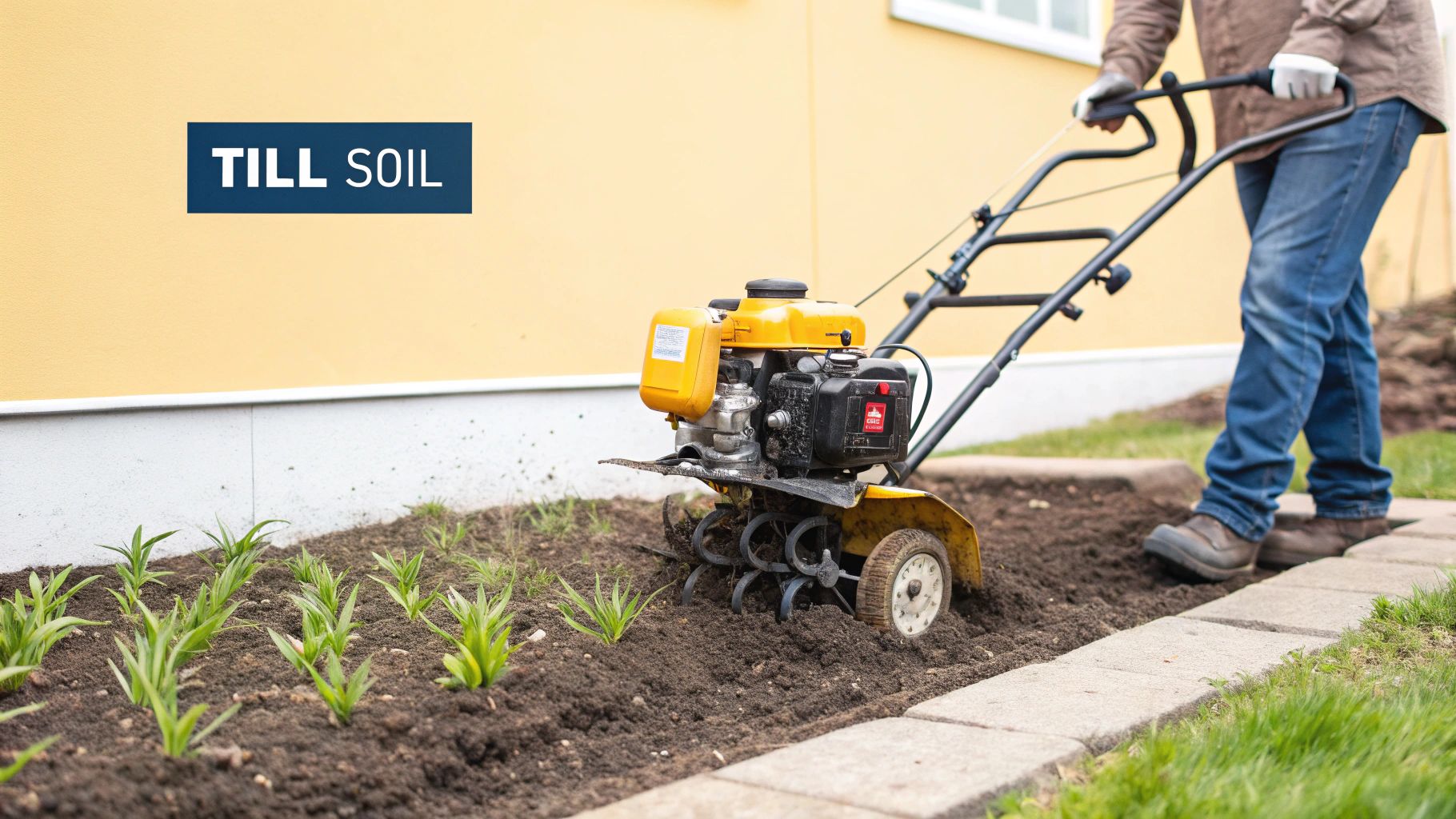
The best method depends on the scale of your project. For a large commercial property or a sprawling residential lawn in the Corpus Christi area, a rototiller is an efficient tool. However, for smaller garden beds, we often recommend a sturdy garden fork or broadfork. Manual tools are gentler, preserving more of the soil’s natural structure and protecting the delicate ecosystem of beneficial microbes and earthworms that aggressive tilling can disrupt.
Tilling Depth and Soil Moisture
How deep should you go? For annual flowers and most vegetables, mixing amendments 4 to 6 inches deep is sufficient. But for permanent installations like shrubs, trees, or deep-rooted perennials, you need to go deeper. We aim for 10 to 12 inches to give those root systems ample room to establish themselves.
Timing is everything. Never till soil when it’s soaking wet or bone-dry. Working with soggy clay creates concrete-like clods that are a nightmare to break apart. Tilling overly dry soil creates dust and prevents an even mix.
Here’s a pro tip: Squeeze a handful of soil. If it crumbles easily when you open your palm, the moisture level is perfect. The ideal consistency is that of a wrung-out sponge.
Low-Till Methods for Long-Term Soil Health
For building exceptional soil with less labor, low-till or no-till methods are excellent. One effective technique is sheet mulching, also known as “lasagna gardening.” This involves layering organic materials—cardboard, compost, leaves, grass clippings—directly on the ground.
Over time, these layers decompose and create incredibly rich, fertile soil without any tilling. This labor-saving method also helps manage a huge challenge we face: soil erosion. Keeping the ground covered protects precious topsoil from washing away in heavy rains. Global soil erosion research confirms just how effective these conservation practices are.
Properly incorporating amendments is hard work, but it’s a step you can’t skip for a thriving landscape. If you’re facing a large project or battling tough South Texas clay, the team at Fischer Landscaping can handle it. Our professional Grading and Dirt Work services ensure your soil is perfectly prepared for years of success.
You’re in the home stretch. After testing, amending, and turning the soil, your garden bed is almost ready. But don’t start planting just yet. Taking a few moments for these final steps will protect your hard work and give new plants the best possible start.
First, level the bed. Tilling often leaves the surface uneven. Use a sturdy garden rake to smooth everything out, breaking up any remaining clods and removing rocks or roots. This isn’t just for aesthetics; a level bed ensures even water distribution, preventing puddles in low spots and dry patches on high ground.
Lock in Moisture with a Good Layer of Mulch
Now for the most important final touch, especially here in South Texas: mulch. Applying a protective layer before planting is a game-changer in our climate, from sun-baked properties in Brownsville to Harlingen. Mulch is your landscape’s first line of defense against our relentless heat.
We always recommend a solid 2- to 3-inch layer of high-quality organic mulch, like shredded hardwood or pine bark. It does far more than just look good.
- Saves Water: It drastically slows evaporation from the soil surface, meaning you water less—a cornerstone of sustainable landscaping in our region.
- Stops Weeds: Mulch blocks the sunlight that weed seeds need to germinate, preventing new plants from competing for water and nutrients.
- Regulates Temperature: It insulates the soil, keeping it cooler in the summer and warmer in the winter, shielding fragile new roots from extreme temperature swings.
Protect Your Hard Work from the Elements
Leaving freshly tilled soil exposed is a recipe for disaster. The sun will bake the moisture out, and one heavy downpour can compact it into a hardpan, washing away your precious topsoil. A global study on Nature.com reinforces this point, showing that keeping soil covered is one of the most critical factors for its long-term health.
By applying mulch immediately, you are putting a protective seal on your investment. You create a stable, sheltered environment where new plants can establish themselves without fighting for survival from day one.
Of course, great soil is just the beginning. You’ll want to pair it with smarter garden pest control strategies to keep things thriving. And if you’re looking to create a landscape that works with our local climate instead of against it, you should definitely check out our guide on xeriscaping landscaping in Corpus Christi.
Protecting your new garden bed is the final, non-negotiable step. If you’d rather have an expert handle the heavy lifting, contact Fischer Landscaping for a quote. We’ll build the perfect, protected foundation for the landscape you’ve always wanted.
Answering Your South Texas Soil Prep Questions
We’ve covered the key steps, but our experience shows that working with South Texas soil always raises more questions. Turning our tough local ground into a thriving garden bed is where hands-on expertise really shines. Let’s address some of the most common questions we hear from clients in Corpus Christi, San Antonio, and across the region.
How Often Should I Amend My Soil?
For annual vegetable gardens and flower beds, you should add a fresh 1 to 2-inch layer of compost each time you plant a new crop for the season. This replenishes the nutrients used by the previous plants.
For permanent landscapes—trees, shrubs, and lawns—the approach is different. A top-dressing of compost every year or two is usually sufficient. The initial heavy-lifting during installation is what matters most. However, our intense summer heat means you can’t just set it and forget it. A long-term soil health plan, which a professional can help develop, is the key to lasting success.
Can I Just Add Topsoil Over My Clay?
This is a tempting shortcut that almost always backfires. Simply dumping a layer of quality topsoil over compacted clay creates a “bathtub effect.” Water drains through the new soil, hits the dense clay layer, and pools there. This creates a soggy, low-oxygen environment that is a perfect breeding ground for root rot.
The correct method is to blend the new topsoil into the native ground, breaking up that hardpan to create a smooth transition. This encourages roots to grow deep, making your plants far more resilient to drought. This is a non-negotiable step in our Grading and Dirt Work projects.
The biggest mistake we see is skipping the soil test. Without it, you’re just guessing. Adding the wrong amendments to our already alkaline soil can do more harm than good, wasting your time, money, and effort.
When Is The Best Time To Prepare Soil?
Most seasoned landscapers will tell you that fall is the ideal time. When you prepare beds in the autumn, the amendments have the entire winter to break down and integrate with the soil. By spring, you have a perfectly conditioned, nutrient-rich foundation ready for planting.
That said, don’t let the calendar stop you. Preparing your soil in the spring is still absolutely critical for a successful summer landscape. The key takeaway is this: never skip the prep work, no matter the season. The professional effort you invest upfront always pays dividends with healthier plants that require less water and maintenance down the line.
Ready to skip the guesswork and the back-breaking labor? The team at Fischer Landscaping has the local knowledge to turn your challenging South Texas ground into the perfect foundation for a landscape you’ll love. Request a quote today and let us build your dream outdoor space from the ground up.