If you've ever dealt with standing water after a heavy South Texas downpour, you know it’s more than just a nuisance. That soggy mess is a serious threat to your lawn, your garden, and even the foundation of your home or business. To truly fix the problem, you need effective drainage solutions for your yard that tackle the root cause, not just the symptoms.
Tackling Water Problems in Your South Texas Yard
For property owners in places like Corpus Christi, San Antonio, and Brownsville, soggy yards are an all-too-common fight. The dense clay soil that’s so prevalent across our region simply can't absorb water fast enough. The result? Puddles that stick around long after the rain stops. Ignoring this can lead to far bigger headaches than just a muddy lawn.
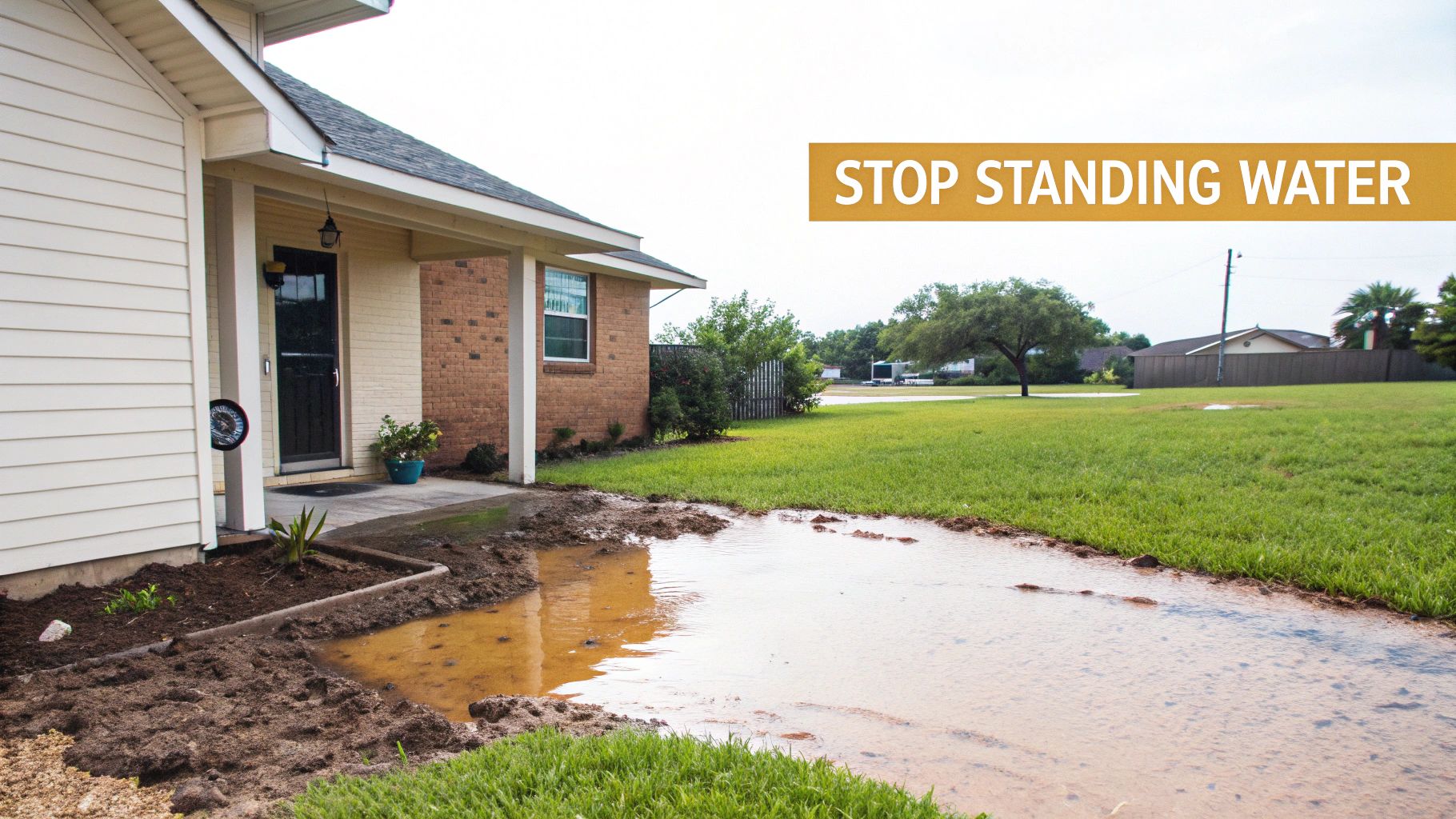
This guide provides a clear, no-nonsense look at professional drainage solutions built for the unique weather patterns we see here in South Texas. We’ll walk through the proven methods that provide lasting results, moving past temporary fixes that fail when you need them most. Knowing your options is the first step toward reclaiming your outdoor space.
The Consequences of Poor Drainage
When water has nowhere to go, it sets off a chain reaction of problems across your entire property. Understanding these risks drives home just how critical a professionally engineered drainage system is for any South Texas property.
- Foundation Damage: Water that pools around your building saturates the soil, creating immense hydrostatic pressure. Over time, this can lead to foundation cracks, water intrusion, and costly structural repairs.
- Landscape Destruction: Excess water suffocates plant roots, leading to yellowing grass, stressed shrubs, and dead trees. It’s also the perfect breeding ground for fungal diseases that can wipe out your landscape investment.
- Pest Infestations: Nothing invites mosquitoes and other pests like standing water. A poorly drained yard can quickly become an unusable, bug-infested space, impacting employee and family comfort.
- Soil Erosion: Uncontrolled runoff doesn't just make a mess; it strips away valuable topsoil and mulch, undermining slopes and damaging expensive hardscaping features like patios and retaining walls.
The need for better water management isn't just a local issue. The global drainage system market was valued at around $40.45 billion and is expected to climb to $86.66 billion by 2035. This growth is fueled by increasing urbanization and shifting climate patterns, which makes professional water management more important than ever. You can review the data in the full report on Market Research Future.
A professional assessment from Fischer Landscaping is the first step toward a permanent solution for a healthy, usable property. We design and install systems that protect your investment for years to come.
Ready to put your property’s water problems behind you for good? A custom-designed system from Fischer Landscaping can turn that soggy lawn into a thriving outdoor oasis. Don't let minor puddles turn into major disasters. Contact us today to request a personalized quote and protect your South Texas property.
Getting to the Bottom of Your Drainage Issues
Before you can solve a drainage problem, you have to become a water detective. Tackling the symptom—that stubborn puddle that never seems to dry out—without understanding the root cause is a surefire way to waste time, effort, and money. A lasting solution starts with a proper diagnosis of why water is pooling instead of draining away.
This isn't just about a quick look outside after a South Texas downpour. It’s about observing how water behaves on your property. Where does it flow? Does it sheet across the lawn and pool against your foundation? Does it carve channels through your flower beds? The answers to these questions are the foundation of a successful drainage plan.
What to Look For: Your Visual Inspection Guide
The next time the skies open up over Corpus Christi or Harlingen, take a walk around your property. This is the single best way to see the problem in action. You’ll gather critical information that’s valuable whether you’re considering a DIY fix or bringing in a professional.
Keep an eye out for these tell-tale signs:
- Puddles That Won't Go Away: Any standing water that lingers for more than 24 hours after the rain stops is a major red flag. Note exactly where these low spots are located.
- A Wet Foundation: Look for damp patches or water stains along the base of your home or building. Water collecting here is a serious threat that can compromise the structure's integrity.
- Washed-Out Areas: Do you see exposed tree roots or channels where mulch or topsoil has been carried away? That’s a clear sign of uncontrolled surface runoff.
- A Struggling Lawn: Constantly soggy soil suffocates grass roots, leading to thin, patchy, or dead spots. Once the underlying water problem is fixed, professional hydroseeding in Corpus Christi, Texas is a fantastic way to quickly re-establish a healthy, dense lawn.
Sometimes the signs are subtle. It helps to know all the indicators, so be sure to learn about the 8 critical signs of water damage to catch problems early.
To help organize your observations, use this simple checklist as you walk your property.
Yard Drainage Problem Identification Checklist
Use this checklist to pinpoint signs of poor drainage and their likely causes on your property.
| Symptom | Common Location | Potential Cause |
|---|---|---|
| Water pooling for 24+ hours | Low spots in lawn, near patios | Improper grading, soil compaction |
| Damp foundation or basement | Along the base of the house | Negative grade, clogged gutters |
| Soil or mulch erosion | Slopes, garden beds, downspouts | Concentrated water flow, lack of ground cover |
| Spongy, soft ground | Throughout the yard | High water table, heavy clay soil |
| Wilting or yellowing plants | Flower beds, vegetable gardens | Root rot from oversaturated soil |
Taking a few notes with this checklist in hand gives you a powerful diagnostic tool and a clear picture of what's happening.
Tracing the Path of Water
Watching your yard during a heavy rain is incredibly revealing. You can see exactly how water travels from point A to point B. You might discover that runoff from a neighbor’s higher-elevation property is half the problem, or that a single downspout is dumping a torrent of water right where your patio is sinking.
One of the most common culprits, especially in areas with dense clay soil like we have around South Texas, is concentrated flow. Water comes off a roof or a driveway and overwhelms one small area, turning it into a miniature swamp. Pinpointing these flow patterns is essential for designing a targeted, effective solution.
Our Experience Shows: Drainage problems are rarely caused by a single issue. It's almost always a combination of factors—poor grading, compacted soil, and heavy runoff from hardscapes like your roof and driveway all playing a part.
Knowing When to Call in an Expert
A DIY assessment is a great first step, but a professional eye is needed to connect all the dots. A seasoned landscape contractor can take your observations and diagnose the technical reasons behind them, like a subtle grading issue that’s invisible to the untrained eye or severe soil compaction deep below the surface.
An expert from Fischer Landscaping will perform a full site analysis, using specialized tools to measure slopes and test how quickly your soil absorbs water. This detailed evaluation removes the guesswork, ensuring the drainage solution we design is the right one for your property's specific challenges.
Don't let water win the battle for your yard. Contact us today for a professional consultation and let's create a solid plan to solve your drainage problems for good.
Comparing Effective Drainage Solutions for Your Yard
Once you have a handle on what’s causing the standing water, it’s time to choose the right solution. There is no single magic bullet for every soggy lawn; the best drainage solutions are always tailored to the specific problem. It makes a big difference whether you're dealing with surface water from a heavy downpour or the persistent subsurface moisture from our dense South Texas clay soil.
At Fischer Landscaping, we specialize in designing and installing a variety of systems, each with its own strengths. Knowing how they differ is the key to protecting your property for the long haul. Let's walk through the most effective solutions we implement for clients from Brownsville to San Antonio.
The Power of the French Drain
The French drain is a classic for a reason—it’s an incredibly effective way to manage groundwater and moisture hiding just below the surface. Think of it as a hidden, underground channel designed to intercept water as it seeps through the soil, giving it an easy path to follow away from your property.
It’s built from a perforated pipe surrounded by gravel and wrapped in a special filter fabric to keep dirt and sediment from clogging the system. This setup is perfect for protecting foundations, drying out perpetually swampy patches in a lawn, or keeping retaining walls from failing under hydrostatic pressure. A strategically placed French drain can save a waterlogged patio, capturing migrating water from a slope before it causes the hardscaping to shift and crack.
Reshaping the Flow with Landscape Grading
Sometimes the most elegant solution is also the simplest. Landscape grading is the process of physically reshaping the land to direct surface water exactly where to go. The goal is to create a gentle, almost unnoticeable slope that moves rainwater away from your home’s foundation and toward a safe exit point, like the street or a storm drain.
Improper grading is a common problem, even on newer properties across Corpus Christi. If the ground slopes toward your foundation, you’re inviting water problems. Professional grading fixes this by carefully moving and compacting soil to create a positive grade, ensuring water flows away naturally every time it rains.
To help you start thinking about your specific water issues, this decision tree can guide your diagnosis.
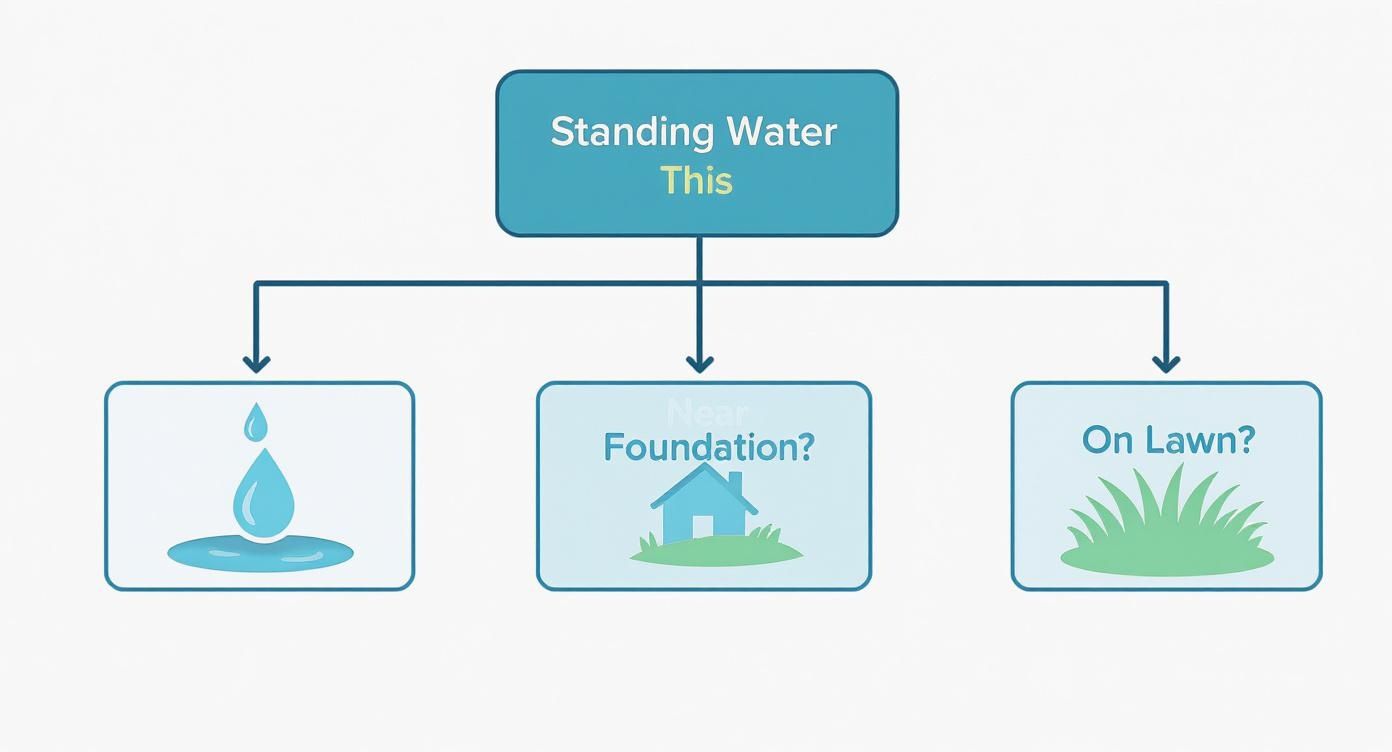
As you can see, figuring out exactly where the water is pooling—whether it's tight against your foundation or out in the open lawn—is the first critical step toward choosing the right fix.
Dry Wells for Targeted Runoff Management
What do you do with the massive gush of water pouring off your roof during a South Texas thunderstorm? A dry well is a fantastic answer. This is a large, underground pit filled with gravel or a prefabricated chamber, designed to collect a high volume of water all at once and then let it slowly soak back into the surrounding soil.
We typically connect dry wells directly to downspouts, capturing roof runoff before it can saturate the ground around your foundation or wash away your landscaping. They are especially useful on flat properties where grading is tricky or in areas with hard, compacted clay that absorbs water at a snail's pace.
We often find that the best results come from combining solutions. For instance, we might use landscape grading to manage general surface water and then install dry wells to handle the concentrated flow from the roof. This creates a complete, layered defense against water damage.
Sustainable and Beautiful Bioswales
For those looking for a more natural, eco-friendly approach, a bioswale is a great option. It’s a shallow, landscaped channel designed to slow down, filter, and absorb stormwater runoff. More than a simple ditch, it's filled with specially selected plants, compost, and soils that are excellent at cleaning pollutants from the water as it soaks into the ground.
Not only does this method manage excess water, but it also creates a beautiful landscape feature that can attract pollinators and improve local water quality. This approach is part of a growing trend toward sustainable practices. A bioswale on a commercial property in Harlingen, for example, can be designed to handle all parking lot runoff while adding valuable, attractive green space.
Deciding between these options really comes down to the specific challenges of your property.
- French Drains are the go-to for subsurface water and protecting structures.
- Landscape Grading is the foundational fix for controlling surface water.
- Dry Wells are specialists, designed to handle heavy, concentrated volumes of water.
- Bioswales offer an aesthetic, green solution for managing and treating stormwater runoff.
The most bulletproof systems often combine several of these elements. A professional consultation is the fastest way to get a clear picture of what’s needed for lasting protection and peace of mind.
Why Quality Materials Are Non-Negotiable for Your Drainage System
Think of a professional drainage solution as a long-term investment in your property's health and value. Like any good investment, its success depends on the quality of its components. Cutting corners on materials is the quickest way to turn a drainage fix into a recurring nightmare, leading to clogs, system failure, and expensive repairs.
At Fischer Landscaping, we’ve been called out to fix failing systems across South Texas, from homes in Corpus Christi to commercial properties in San Antonio. A drainage system buried a foot underground is the last thing you want to dig up every few years. That’s why we are uncompromising about the materials we use.
The Great Pipe Debate: Rigid PVC vs. Corrugated Tubing
The pipe is the backbone of any subsurface system like a French drain. You’ve likely seen the flexible, black corrugated pipe at hardware stores. We strongly advise against using it for any permanent drainage solution. Its accordion-like ridges are a magnet for sediment and debris, creating the perfect trap for future clogs.
This is why rigid PVC (polyvinyl chloride) pipe is the only choice for professionals.
- A Smooth Ride: The interior of a PVC pipe is completely smooth. Water and fine sediment flow right through, dramatically reducing the risk of blockages that can choke off a system.
- Built to Last: PVC is tough. It can handle the immense weight of soil and rock without being crushed, ensuring the drainage channel stays open for decades. Flimsy corrugated pipe can easily collapse during installation or as the ground settles.
- Precision Slope: Because PVC is rigid, we can set it at a precise, consistent slope. This is absolutely critical for ensuring gravity pulls water away effectively and efficiently.
While corrugated pipe might save a few dollars upfront, it’s practically a guarantee you’ll be calling for repairs down the road. Our philosophy is "do it right the first time," which makes smooth-wall PVC a non-negotiable part of every installation we do. It’s the same quality standard we apply to our expert hardscaping services to protect beautiful patios and walkways from water damage.
The Unsung Hero: Non-Woven Geotextile Fabric
If the pipe is the backbone, the filter fabric is the system’s bodyguard. This special material, a non-woven geotextile fabric, is wrapped around the entire gravel-filled trench. Its job is simple but vital: let water in, but keep soil and silt out. Without it, fine particles from the surrounding dirt would eventually wash into the gravel and clog the entire system from the outside in.
This isn't the same flimsy material you'd use for a flower bed. Professional-grade geotextile is engineered for high water flow and incredible durability. It won't tear during backfilling, and it doesn't rot or break down underground.
A drainage system without proper filter fabric is destined to fail. It's not a matter of if, but when. The entire trench will eventually fill with silt, turning your expensive drainage solution into a buried tube of mud.
Choosing the Right Gravel for Our South Texas Soil
Even the rock we use is a deliberate choice, tailored specifically for our region. Here in South Texas, we’re often dealing with heavy, dense clay soils that hold onto water. The gravel in a French drain creates a porous zone where water can collect and easily flow into the perforated pipe.
We exclusively use clean, washed gravel, typically between ¾ inch and 1 ½ inches in diameter. This size strikes the perfect balance—it creates large voids for water to move freely while still being small enough to support the pipe and the surrounding soil. Using unwashed gravel or tiny "pea gravel" is a mistake, as it introduces fine sand and silt that contribute to clogs. For homeowners looking to dive deeper, the National Association of Landscape Professionals is a great resource for industry best practices.
By being selective about every component—from rigid PVC pipe and professional-grade fabric to the right size of clean gravel—we build drainage solutions for your yard that are designed to last. This commitment to quality is how we ensure your investment doesn't just solve today's water problems but protects your property for years to come.
Ready for a drainage solution built to last? Contact Fischer Landscaping today to schedule a consultation and learn how our quality-first approach can provide permanent peace of mind.
What to Expect During a Professional Installation
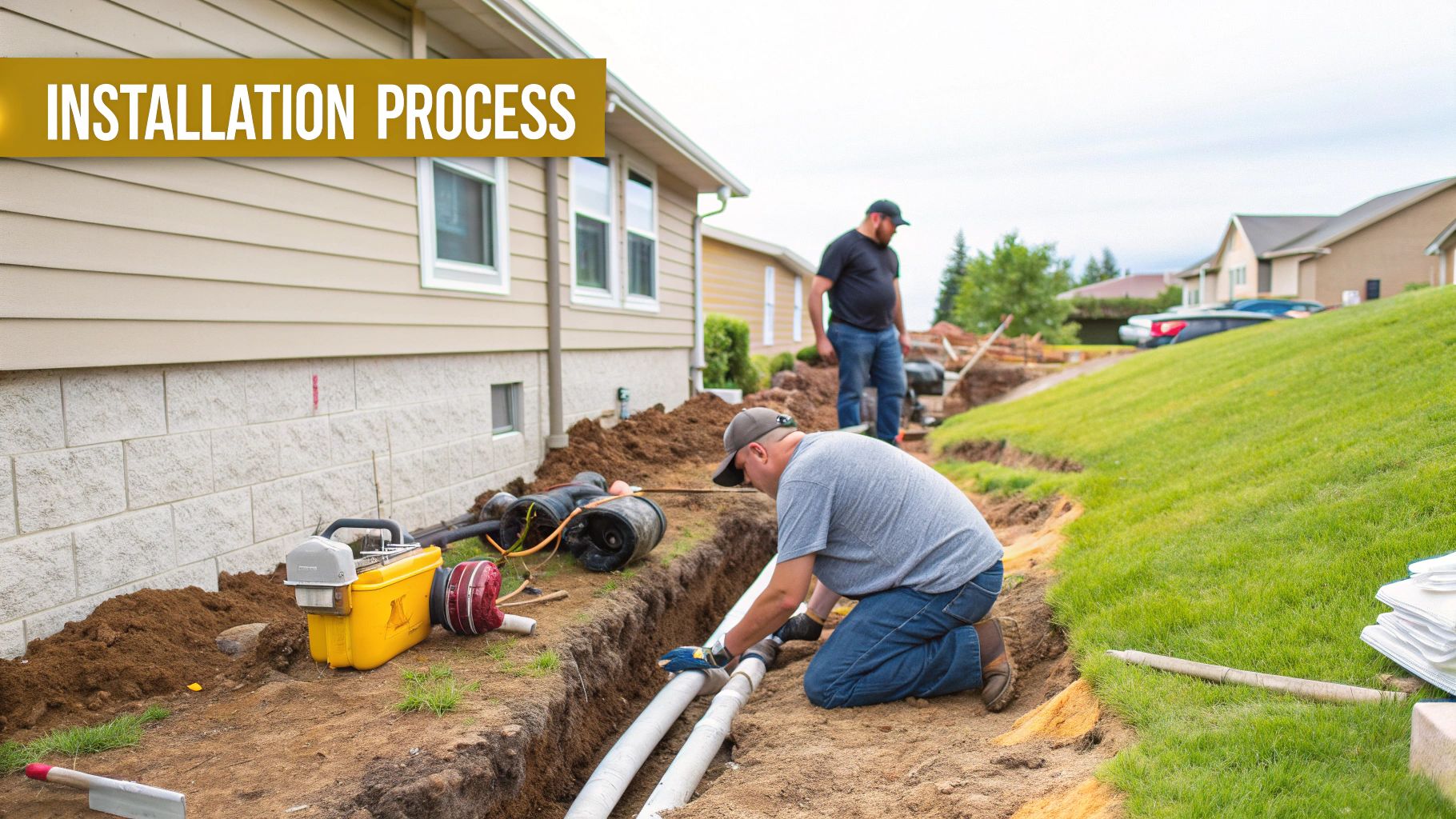
When you hire a professional to install drainage solutions for your yard, the process should be seamless and transparent from start to finish. At Fischer Landscaping, we believe in keeping our clients informed every step of the way. There should be no mystery—just confidence in a project that safeguards your property with minimal disruption.
You’re not just buying pipes and gravel; you're investing in a well-managed project that protects your home and delivers a guaranteed outcome. From our initial site walk in Corpus Christi to the final cleanup in San Antonio, our workflow is built on precision and respect for your property.
Initial Site Analysis and Custom Design
The first phase is the most critical. One of our experts will visit your property for a comprehensive site analysis. This is far more than just eyeing puddles. We use professional equipment to measure slopes, test soil compaction, and map out exactly how water moves across your land.
All that data feeds into a custom design. We determine the perfect placement for French drains, calculate precise grade adjustments, or identify the most effective spot for a dry well. This detailed blueprint ensures the final solution is built for your yard's specific challenges, not a one-size-fits-all guess.
Careful Excavation and Precision Installation
Once you approve the plan, our skilled crew gets to work. This begins with careful, strategic excavation. We know how much your lawn and garden mean to you, so we focus on minimizing our footprint. We use the right-sized equipment to protect your existing landscaping and hardscapes.
The installation itself is where craftsmanship comes in. Whether we're laying rigid PVC pipe at a precise grade, lining trenches with tough geotextile fabric, or backfilling with clean, washed gravel, every step is done with meticulous care. This attention to detail is what separates a temporary patch from a permanent turf installation and drainage system built to last for decades.
For larger projects involving significant digging, managing displaced soil and debris is crucial. In these cases, using professional grab lorry waste removal services can be an efficient way to keep the site clean and safe.
Meticulous Site Cleanup and Restoration
A project isn't finished just because the system is in the ground. For us, the last step is restoring your property completely. We take great pride in leaving your yard looking as good as—or even better than—it did when we arrived.
This includes:
- Backfilling and Compacting: We carefully return soil to all excavated areas and compact it properly to prevent future settling and low spots.
- Re-sodding or Seeding: Any disturbed parts of the lawn are professionally repaired with high-quality sod or seed for a seamless, uniform appearance.
- Final Grading: We perform a final grade check to confirm water will flow exactly as planned.
- Thorough Cleanup: All our equipment, leftover materials, and debris are hauled away. You’re left with nothing but a clean, beautiful, and functional outdoor space.
Our goal is simple: to solve your drainage problem with the least amount of disruption to your life. Our team respects your property as if it were our own from the moment we arrive until the job is complete.
Modern drainage solutions are also getting smarter. Permeable pavements and modular systems are becoming more common because they effectively manage stormwater. In fact, the market for these modern systems is projected to hit $2.3 billion by 2029. You can read the full research on advancements in modern drainage systems to see how technology is changing water management.
If you’re ready for a professional, transparent process that delivers lasting results, it’s time to talk to an expert. Contact Fischer Landscaping today for a personalized quote and let us show you how a properly managed installation can protect your South Texas property.
Keeping Your Drainage System Working and Your Property Safe
You've made a smart investment in your property by installing a professional drainage system. Now, a little bit of upkeep is all it takes to ensure that system protects your home and yard for the long haul. The best part? It's usually pretty simple.
If your system uses catch basins or grates, your main job is to keep them free of debris. Make it a habit to clear away leaves, grass clippings, and anything else that might block the flow of water, especially after mowing or a big storm. A simple clog at the intake can sideline your entire system during a heavy South Texas rain.
The High Price of Doing Nothing
Putting off a drainage problem is a risky bet. What starts as a soggy patch in the lawn can quickly spiral into serious, and sometimes irreversible, damage to your property in Corpus Christi or San Antonio.
- Foundation Damage: When soil around your home is constantly saturated, it puts incredible pressure on your foundation. This can lead to cracks, leaks, and even structural failure—repairs that can easily cost tens of thousands of dollars.
- A Ruined Landscape: Waterlogged soil is a death sentence for plant roots. It suffocates them, killing off valuable trees, shrubs, and grass. A vibrant lawn is a huge part of your landscape, which is why our professional turf installation is often the final step after we've corrected a property's drainage.
- Pest Problems: Standing water is an open invitation for mosquitoes and other pests, turning your backyard into a place you can't even enjoy.
Ultimately, a well-designed drainage solution buys you peace of mind. Knowing your property is safe from water damage lets you actually relax and enjoy your outdoor space, no matter what the weather is doing.
If you’re tired of worrying about water every time it rains, it’s time to find a permanent solution.
Take the first step toward reclaiming your yard and protecting your home. Contact Fischer Landscaping today for a personalized consultation, and let our experts design a drainage system that solves your water problems for good.
Answering Your Yard Drainage Questions
When it comes to tackling soggy lawns here in South Texas, we've heard just about every question in the book. If you're wondering about the practical side of getting a professional drainage system, you're not alone. Here are some straightforward answers to the questions we get asked most often.
What’s the Real Cost of a Drainage System?
This is always the first question, and the honest answer is: it depends. The final price is shaped by the size and type of system we're installing, ease of access to your property, and the specific materials needed to do the job right.
Think of it less as a cost and more as an investment. A professionally installed system is your best defense against the truly eye-watering expense of foundation repairs or replacing drowned landscaping and essential hardscaping. Getting a custom quote is the only way to know for sure, but the value it protects is almost always worth it.
How Long Will My Yard Be a Construction Zone?
For most residential jobs—like a standard French drain or landscape regrading—we're typically in and out in about 2 to 5 days.
Of course, we're working with Mother Nature. A sudden South Texas downpour, which isn't exactly rare in places like Brownsville and Harlingen, or hitting unexpectedly tough soil can shift the timeline. We always set a clear, realistic schedule upfront so you know exactly what to expect before we ever break ground.
"Will this destroy my lawn?"
This is a huge concern for homeowners, and it's completely understandable. The reality is, yes, there's digging involved. But our entire process is designed to be as surgical and minimally invasive as possible. We meticulously plan the project and, once the system is in, we focus on a complete site restoration. We leave your property clean, tidy, and perfectly prepped for a new turf installation if that's part of the plan.
Hopefully, this clears up some of the mystery around solving your yard's water woes for good. Taking action now is the smartest way to protect your property's value for years to come.
Don't let standing water dictate how you use your property. For a permanent fix designed for the unique challenges of South Texas soil and weather, trust the experts at Fischer Landscaping. Contact us today for a personalized quote.