When selecting the best wood for outdoor decks in South Texas, you need a material that balances beauty, budget, and resilience against our demanding climate. For homeowners from Corpus Christi to San Antonio, the decision often comes down to pressure-treated pine for affordability, cedar for its natural elegance, and tropical hardwoods like Ipe for unparalleled durability. Your final choice will depend on your upfront budget and how much maintenance you're prepared to handle.
Selecting Decking Materials for the South Texas Climate
Building a deck is one of the best investments you can make in your South Texas home or business. However, our unique environment—from the humid, salty air in Brownsville to the intense sun in Harlingen—is tough on wood. The wrong material can quickly warp, rot, or fall victim to insects, turning your beautiful outdoor retreat into a constant maintenance headache. A great deck starts with choosing a material engineered to handle these specific challenges.
To make the right choice, you need to balance three key factors:
- Budget: The initial cost varies significantly, from the economical price of pressure-treated pine to the premium investment required for tropical hardwoods.
- Durability: Consider how well the wood naturally resists rot, pests, and the warping caused by our region's heat and humidity.
- Maintenance: Be realistic about the time and money you are willing to commit to yearly sealing, staining, and cleaning to protect your investment.
This infographic provides a clear overview of the essential factors for your South Texas deck.
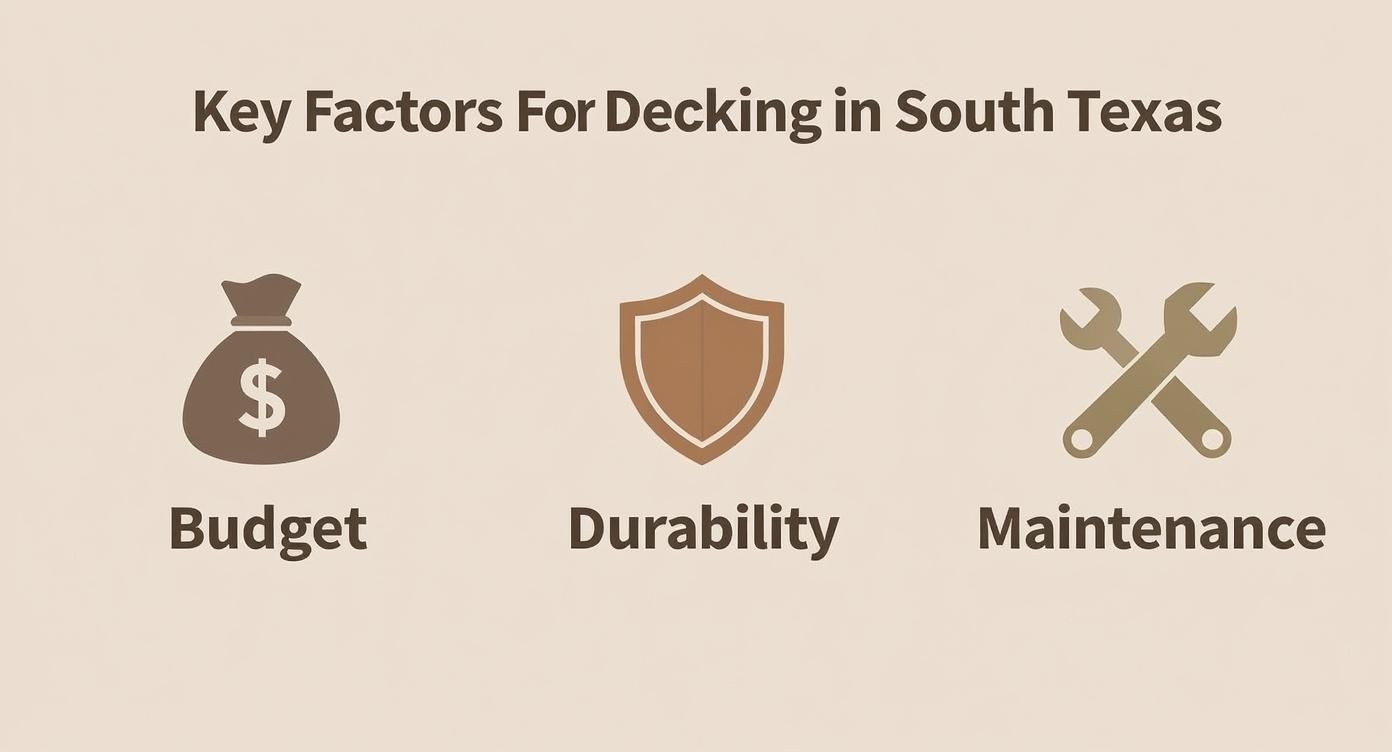
As you can see, the perfect material lies at the intersection of your budget, performance needs, and maintenance commitment. Each wood type offers a unique combination of these attributes. Understanding these trade-offs is the first step toward creating an outdoor space that is not only beautiful but built to last. Partnering with professional hardscaping services like Fischer Landscaping ensures you navigate these choices correctly, finding the ideal fit for your property and lifestyle.
To simplify the decision, here's a quick comparison of how the most popular options perform in our local environment.
South Texas Decking Wood At a Glance
This table offers a snapshot of the top decking materials, helping you weigh the pros and cons for a deck built to withstand our region's climate.
| Wood Type | Typical Lifespan in South Texas | Maintenance Demands | Upfront Cost | Ideal Use Case |
|---|---|---|---|---|
| Pressure-Treated Pine | 10-15 Years | High (Annual Sealing) | $ | Budget-conscious projects |
| Cedar / Redwood | 15-25 Years | Moderate (Periodic Sealing) | $$ | Natural aesthetics with good durability |
| Tropical Hardwood (Ipe) | 40+ Years | Low (Optional Oiling) | $$$$ | High-end, long-term investments |
| Composite | 25-30+ Years | Very Low (Occasional Cleaning) | $$$ | Low-maintenance modern decks |
Consider this your starting point. Pressure-treated pine is a cost-effective solution, but be prepared for consistent upkeep. If you desire a stunning, natural look with less work, Cedar is a fantastic middle-of-the-road choice. For those who want a deck that will likely outlast their home with minimal fuss, Ipe is the gold standard—if it aligns with your budget.
Pressure-Treated Pine: The Budget-Friendly Mainstay
For many homeowners and property managers, pressure-treated (PT) pine is the first material they consider for a new deck. Its main advantage is its price. For clients across South Texas, from Corpus Christi to San Antonio, the low upfront cost makes it an attractive starting point for creating an outdoor living space. It's the most common decking material for a reason.
But how does it hold up in our harsh coastal climate? The term "pressure-treated" means the pine has been chemically infused to resist rot and insects—two major threats in our area. While the treatment is effective, it doesn’t alter the wood's inherent characteristics.
Performance Under Pressure
At its core, PT pine is a softwood, making it susceptible to the extreme heat cycles we experience in places like Harlingen and Brownsville. The wood continuously expands in the sun and contracts as it cools, and this movement takes a toll over time.
This constant expansion and contraction can lead to several common issues:
- Warping or twisting as boards dry unevenly after rain.
- Cracking and splitting on the surface, creating splinters.
- Shrinking, which can lead to wider, uneven gaps between deck boards.
While the chemical treatment protects PT pine from rot and insects, the wood itself is still vulnerable to our climate's physical demands. Its lifespan is directly tied to diligent maintenance and expert installation—cutting corners on either will lead to costly repairs later.
The Non-Negotiable Maintenance Routine
To ensure your PT pine deck lasts, a commitment to regular upkeep is non-negotiable. Without a protective sealer, our relentless sun will damage the wood fibers, and the high humidity will encourage mildew growth. A well-maintained PT pine deck can last 10 to 15 years, but that longevity depends entirely on your maintenance habits.
Achieving that lifespan requires an annual cleaning and sealing ritual. This process shields the wood from moisture and UV damage, preventing it from turning gray and weathered. If you choose this route, it pays to research the best paint for treated wood projects to ensure maximum protection.
In conclusion, PT pine is a practical choice for homeowners on a tight budget who don't mind annual maintenance. However, professional installation is crucial to maximize its performance. At Fischer Landscaping, we use specialized fastening techniques and proper board spacing to account for the wood's natural movement, giving you a solid, durable deck from the start.
Cedar and Redwood: A Leap in Natural Beauty and Performance
When you’re ready to upgrade from standard pressure-treated pine, cedar and redwood are the natural next step. These classic softwoods offer a perfect blend of genuine elegance and rugged performance, instantly elevating any outdoor space with their rich, warm tones and beautiful grain. It's a significant improvement in both your deck's appearance and its long-term durability.
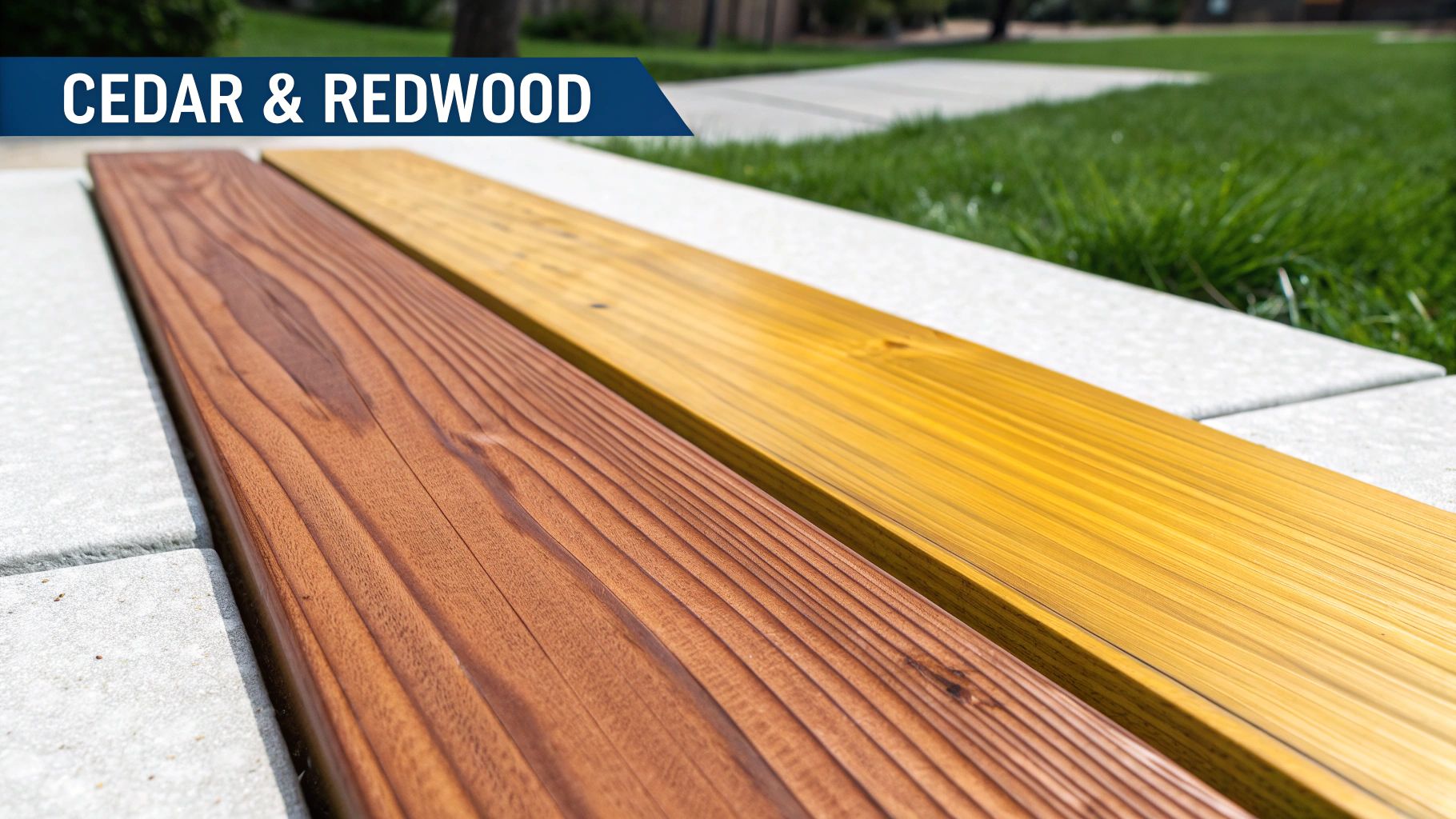
The true advantage of these woods lies within their natural properties. Unlike pine, which requires chemical treatments for survival, cedar and redwood have built-in defense mechanisms. They contain natural oils and tannins that resist rot, decay, and the insects common to our South Texas humidity. This inherent resilience is why they are considered among the best wood for outdoor decks available.
Holding Strong in the Texas Sun
One of the most significant advantages cedar and redwood have over treated pine is their dimensional stability. Because they contain less water and resin, they are far less likely to warp, twist, or shrink under the intense sun and temperature fluctuations we see here in San Antonio and the Coastal Bend.
This stability results in a deck that remains flatter and more uniform for years, minimizing future problems. While no wood is entirely maintenance-free, their natural durability means you're investing in a material that works with you, not against you.
With proper care, both woods offer impressive longevity. A well-constructed and maintained cedar or redwood deck can easily last 15 to 25 years, providing decades of value and enjoyment. You can learn more about factors that impact how long your wood decking can last to maximize its lifespan.
Balancing Aesthetics and Upkeep
The stunning appearance of cedar and redwood is a major part of their appeal. Their deep, reddish-brown hues bring a touch of luxury to any backyard. If you prefer a more rustic look, they can be left to age naturally, weathering to a beautiful silver-gray patina that has its own unique charm.
Cedar and redwood offer the ideal compromise. You get the authentic look and feel of real wood, combined with powerful, natural resistance to decay and insects. It's a smart investment for a deck that's both beautiful and structurally sound.
While more resilient than pine, they do require consistent care to maintain their appearance in our climate.
- Periodic Sealing: To preserve their beautiful color and protect them from moisture, apply a quality UV-blocking sealer every two to three years.
- Regular Cleaning: Keeping the deck free of leaves, dirt, and debris helps prevent mildew and stains. Our professional pressure washing services can safely restore your deck's beauty when a deeper clean is needed.
Yes, the upfront cost for cedar and redwood is higher. But for homeowners who value natural beauty and want a reliable, high-performing deck without the constant maintenance of pressure-treated pine, it's an investment that pays for itself. When you're ready to build a timeless outdoor living area, the Fischer Landscaping team is here to help you design it right.
Tropical Hardwoods: The Ultimate in Durability
For clients who demand the absolute best, tropical hardwoods are in a league of their own. For homeowners and businesses that prioritize performance and longevity above all else, materials like Ipe represent the pinnacle of decking. This is more than just building a deck; it's about making a long-term investment in your property that will last for decades.
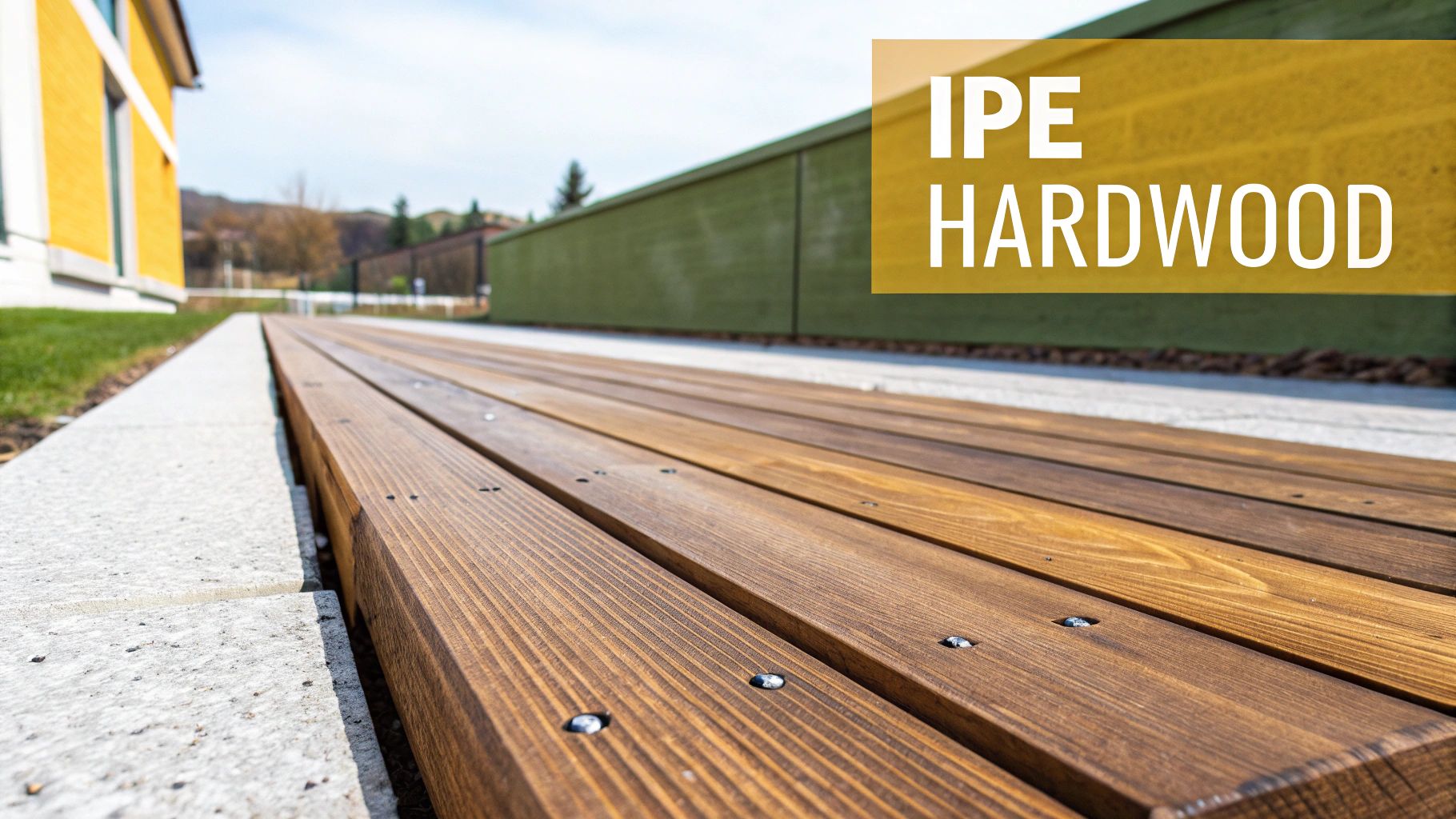
The secret to their performance is incredible density. Evolved in rainforests, these woods are naturally equipped to combat constant moisture and insects. This inherent resilience makes them an ideal match for the demanding coastal climate of Corpus Christi, where high humidity and pests are a constant challenge.
Unmatched Resistance and Longevity
Tropical hardwoods like Ipe are so dense that they naturally resist nearly every threat a South Texas deck faces. Their tight grain is almost impervious to moisture, preventing rot and decay without chemical treatments. This same hardness makes them unappealing to termites and other wood-boring insects.
Consider these real-world advantages:
- Remarkable Lifespan: With basic care, an Ipe deck can easily last 40 years or more. In many cases, it will outlive the home it’s attached to.
- Fire Resistance: Ipe has a Class A fire rating—the same as concrete and steel. This provides an important, and often overlooked, layer of safety for your property.
- Exceptional Strength: The wood is incredibly tough, resisting the scratches, dents, and daily wear that can easily damage softer woods.
Tropical hardwoods are a true long-term investment. The significant upfront cost is offset by decades of minimal maintenance and unparalleled durability, delivering exceptional value for high-end properties and homeowners who never want to replace their deck again.
The Importance of Professional Installation
While the benefits are clear, the extreme hardness that makes these woods so durable also makes them challenging to work with. Standard tools struggle against the dense boards, and every screw hole must be pre-drilled to prevent splitting.
This is not a DIY project; it is a specialized craft that demands seasoned professionals.
Attempting to install Ipe without the right equipment and experience often leads to costly mistakes, wasted material, and a finish that doesn't do justice to your investment. To achieve the flawless, long-lasting result this premium material deserves, partnering with an experienced hardscaping team is essential.
At Fischer Landscaping, we have the specialized tools and proven techniques to install your tropical hardwood deck to perfection. We ensure every board is cut with precision and fastened securely, creating a stunning outdoor space that will stand the test of time, whether you're in San Antonio or Brownsville. Contact us for a custom quote and let's start designing your ultimate deck.
Composite Decking: The Low-Maintenance Alternative
While we've focused on the best woods for an outdoor deck, the conversation isn't complete without discussing its biggest competitor: composite decking. In recent years, composite has become a market leader, offering South Texas property owners a modern, high-performance option that avoids many of the issues associated with traditional wood.
This engineered material, typically a blend of wood fibers and recycled plastics, was designed to solve the biggest challenges natural wood faces in our coastal climate. For any busy homeowner or property manager in Corpus Christi, its most attractive feature is its minimal maintenance.
Engineered for the South Texas Climate
Composite boards are manufactured to be incredibly dense and non-porous. This process gives them a powerful, built-in resistance to the elements that destroy decks in our region, meaning you can forget the constant upkeep that many wood types require.
Here’s how it holds up:
- Rot and Decay Resistance: The plastic component creates a moisture barrier, preventing the fungal growth that causes rot in our humid environment.
- Warp and Splinter Proof: Composite material is dimensionally stable, so it won’t twist, crack, or splinter after exposure to the intense Texas sun.
- Insect Resistance: Its synthetic composition is completely unappetizing to termites and other wood-boring pests.
For property owners who want the benefits of a deck without the demanding annual maintenance schedule, composite is a game-changer. The higher upfront cost is a direct trade-off for decades of saved time, effort, and money on repairs and refinishing.
Long-Term Value and Minimal Upkeep
While the initial price of composite decking is higher than pressure-treated pine or even cedar, its long-term value is where it truly shines. With an average lifespan of 25 to 30 years or more, it easily outlasts most traditional wood options.
This longevity is a direct result of its inherent resilience. You avoid the recurring costs of stains, sealers, and the labor required to apply them every few years. The maintenance routine is simple: an occasional cleaning to remove surface dirt is usually all that's needed.
For a deeper clean, our professional pressure washing services can safely restore your composite deck’s original appearance without damaging the material.
Ultimately, the choice between natural wood and composite comes down to your priorities. If you want a hands-off, ultra-durable outdoor space that will look great for decades with minimal effort, composite decking is an exceptional choice. The team at Fischer Landscaping can guide you through the top-quality composite options to find the perfect fit for your home or business.
Making the Right Choice for Your South Texas Property
Choosing the best wood for your deck comes down to your budget, your desired aesthetic, and how much time you're willing to dedicate to maintenance. There is no single "best" wood for everyone—the right choice is the one that fits your lifestyle and your home here in South Texas.
To help you decide, consider which of these profiles best describes you:
The Budget-Conscious DIYer
If your main goal is to build a deck without a large upfront cost and you don't mind an annual weekend project, then pressure-treated pine is a practical and effective option. It requires regular sealing and care but delivers excellent value for its price.
The Aesthetics-Focused Owner
For those who want the undeniable beauty of real wood but prefer to avoid the constant upkeep of pine, cedar is the perfect middle ground. It offers a gorgeous, natural look with far less maintenance, striking an ideal balance between beauty and practicality.
The Long-Term Investor
If you're looking for a deck that will stand the test of time and look stunning for decades with minimal fuss, you should consider tropical hardwoods like Ipe or a high-quality composite. These are top-tier choices for a reason—they’re built to last.
Your deck isn’t just a structure; it’s an extension of your home and your lifestyle. The material you choose should support everything from quiet morning coffees to lively family barbecues for years to come.
It's also worth exploring hot outdoor living and decking trends for fresh inspiration. Simple additions like custom outdoor lighting can completely transform your deck's ambiance and extend its usability into the evening.
Ultimately, the best way to feel confident in your choice is to discuss it with an expert. At Fischer Landscaping, we help homeowners and businesses in Corpus Christi and San Antonio navigate these decisions every day. We're committed to delivering practical, solution-driven hardscaping that enhances your property's value.
Common Questions About Building a Deck in South Texas
When planning a deck project, especially in our unique Coastal Bend climate, a few questions always arise. We hear them from clients across Corpus Christi, San Antonio, and the surrounding areas, so we've compiled straightforward answers to help you make an informed decision.
How Does Coastal Humidity Affect My Deck Wood Choice?
The humidity along the coast, from Corpus Christi down to Brownsville, is relentless—it's the primary enemy of wood, promoting rot and mildew. This makes your choice of material absolutely critical.
Woods that are naturally dense and moisture-resistant are by far the best choice. Tropical hardwoods like Ipe lead the pack, while resilient softwoods like cedar also perform very well. Although pressure-treated pine is a viable option, it demands a strict annual sealing schedule to keep moisture out. Skipping a year will cause it to show wear much faster here than it would inland.
Is Ipe Really Worth the Higher Cost in San Antonio?
For most homeowners who plan to remain in their homes long-term, the answer is a resounding yes. Ipe’s incredible density makes it a fortress against the intense San Antonio summer heat and the pests that thrive here. It simply does not warp, cup, or crack like softer woods do under pressure.
Consider this: an Ipe deck can easily last three to four times longer than a standard pressure-treated pine deck. When you factor in its longevity and minimal repair costs, the upfront investment provides exceptional long-term value.
What’s the Single Most Important Deck Maintenance Task in Texas?
Regardless of the wood you choose, keeping it clean and protected is the number one priority. The specific approach varies slightly depending on the material.
- For Pine and Cedar: Plan for an annual cleaning and sealing. A high-quality water-repellent sealer with UV blockers is essential to protect against both moisture and the harsh Texas sun.
- For Tropical Hardwoods: A yearly application of hardwood oil will preserve the rich, vibrant color. However, if you prefer a more hands-off approach, you can allow it to weather to a beautiful silver-gray without compromising its structural integrity.
Proper care is what transforms a good deck into a great one that you can enjoy for years. It’s a small commitment that protects your investment and keeps your outdoor space looking its best.
Ready to build the perfect deck for your South Texas home or business? The expert team at Fischer Landscaping has the experience to guide you through every step, from selecting the right materials to professional, high-quality installation. We specialize in creating durable, beautiful, and functional hardscapes that add value to your property. Contact us today for a personalized quote!