
For most lawns in South Texas, a good starting point is to water each sprinkler zone for about 30 to 45 minutes, two or three times a week. This is the short answer, but it's effective. This strategy drives water deep into the soil, encouraging robust root growth and building a resilient lawn that can withstand our intense local heat.
Forget the myth of daily watering. The professional secret to a lush lawn in Corpus Christi or San Antonio is to water deeply, but less frequently.
The Foundation of a Healthy South Texas Lawn
Achieving a vibrant, healthy lawn in our South Texas climate isn't about the frequency of watering—it's all about depth. Your primary goal should be to moisten the top six inches of soil with each watering session. When you accomplish this, grass roots are forced to grow deeper to find moisture, creating a strong, drought-tolerant foundation for your entire lawn.
Watering for a few minutes every day does the opposite. It encourages shallow roots that stay near the surface, making your lawn dependent on constant moisture and vulnerable to heat stress and disease. By switching to a deep and infrequent schedule, you are essentially training your grass to be tougher and more self-sufficient.
Why Deeper Is Better
This isn't just an opinion; it's a proven landscaping strategy that works exceptionally well for our climate. Proper irrigation is critical because both overwatering and underwatering can ruin your turf. A correctly hydrated lawn is also your best defense against the common pests and fungal diseases that thrive in the South Texas humidity.
Here are the key benefits of watering deeply:
- Stronger Root Systems: Deep roots are naturally protected from scorching surface temperatures and can access moisture reserves further down in the soil.
- Increased Drought Resistance: A deep-rooted lawn can survive longer between waterings, even during the peak of a Harlingen summer.
- Reduced Weed Growth: Watering less often allows the soil surface to dry out, making it much harder for shallow-rooted weeds to germinate and establish themselves.
- Water Conservation: You'll use water more efficiently, reducing wasteful runoff and ensuring every drop is absorbed where it's needed most. This is both environmentally responsible and cost-effective.
A smart watering plan is the cornerstone of great lawn care, but it works best when you start with healthy, high-quality grass. The right type of turf, installed correctly, will respond much better to an optimized watering schedule. If you're establishing a new lawn or renovating an old one, professional turf installation can make a significant difference in achieving that perfect green carpet.
Calculate Your Sprinkler System's Water Output
The general advice to water for 30-45 minutes is a solid starting point, but it's still an estimate. Every sprinkler system is different. Your home's water pressure, the types of nozzles used, and the spacing between sprinkler heads all affect its "precipitation rate"—how much water your lawn actually receives in a given time.
To move from guesswork to a precise and effective watering plan, you need to determine that rate.
A classic, simple method for this is the "tuna can test." It's a low-tech but highly accurate way to measure your system’s output in inches per hour, taking the mystery out of your irrigation.
How to Run the Tuna Can Test
First, gather several identical, flat-bottomed containers. Empty tuna or cat food cans are ideal for this.
- Place at least 5-7 empty cans randomly across a single sprinkler zone. Spreading them out is crucial for getting an accurate average, as sprinkler coverage is rarely perfect.
- Run that sprinkler zone for a set amount of time. We recommend 20 minutes—it's long enough to collect a measurable sample of water.
- After 20 minutes, turn off the water. Use a ruler to carefully measure the depth of the water in each can and write down each measurement.
To find the average, add up all your measurements and divide the total by the number of cans you used.
For example, if you used five cans and your measurements were 0.4", 0.5", 0.4", 0.6", and 0.5", the total is 2.4 inches. Divide that by 5, and your average depth is 0.48 inches collected in 20 minutes.
Turning Your Measurement into a Watering Schedule
With that average, one simple calculation will give you your system's precipitation rate. Since the test ran for 20 minutes (one-third of an hour), multiply your average depth by three.
In our example: 0.48 inches x 3 = 1.44 inches per hour.
This number is invaluable. You now know your system delivers approximately 1.5 inches of water per hour. You can use this to calculate exactly how long to run your sprinklers to deliver the one inch of water your lawn needs per session.
The Takeaway: Instead of a generic 30 minutes, you can now set a precise time. To get one inch of water from a system that outputs 1.5 inches per hour, you would need to run it for approximately 40 minutes.
This process gives you complete control. However, this test can sometimes be skewed by hidden issues like low pressure or clogged nozzles. For a truly professional assessment in Corpus Christi or Brownsville, a detailed irrigation audit from Fischer Landscaping can identify these problems and ensure every drop of water is used effectively.
This infographic breaks down the essentials for a deep watering routine.
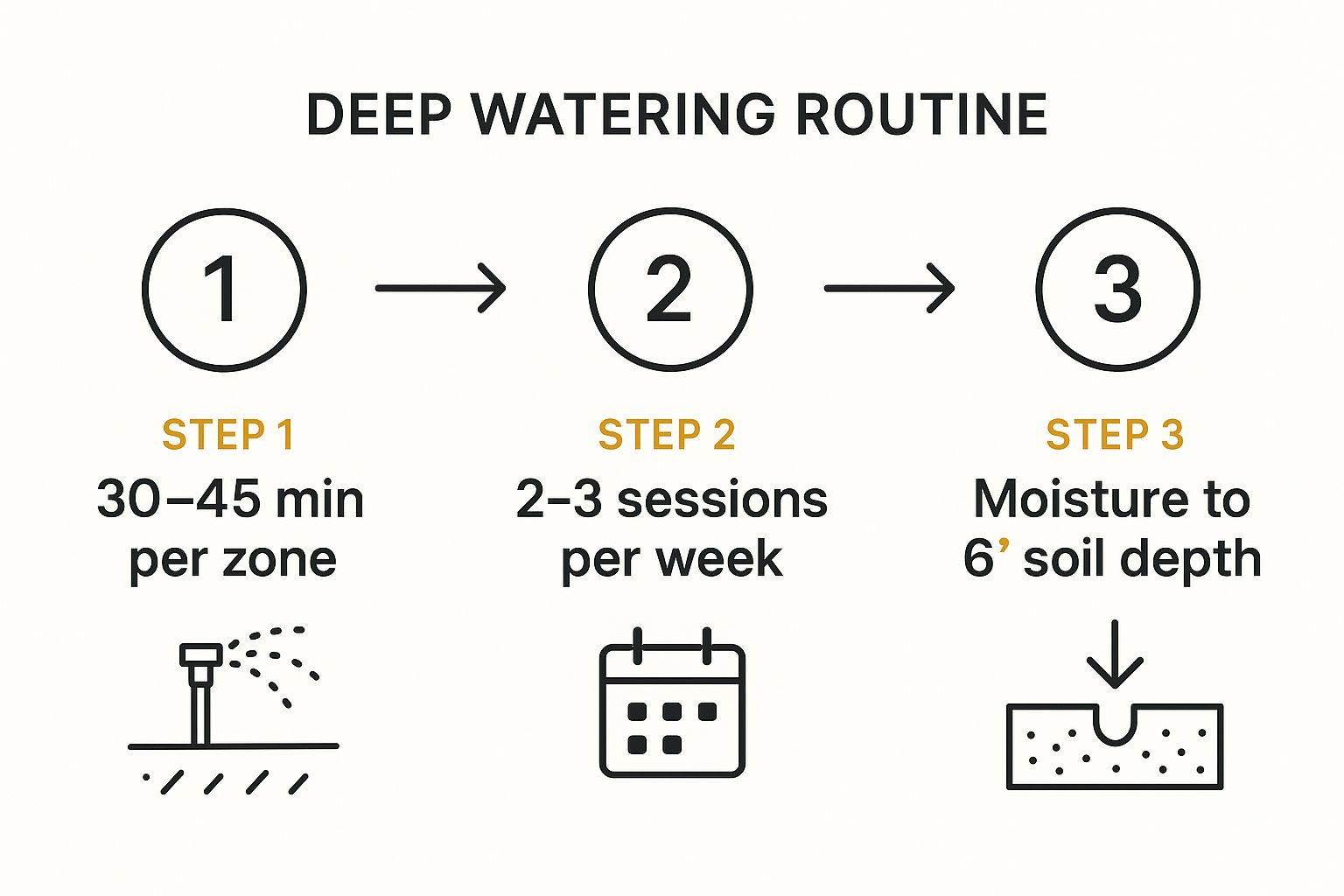
It’s a great visual reminder of the three core elements—duration, frequency, and depth—that work together to build a strong, resilient South Texas lawn.
Put Your Watering on Autopilot with Smart Irrigation
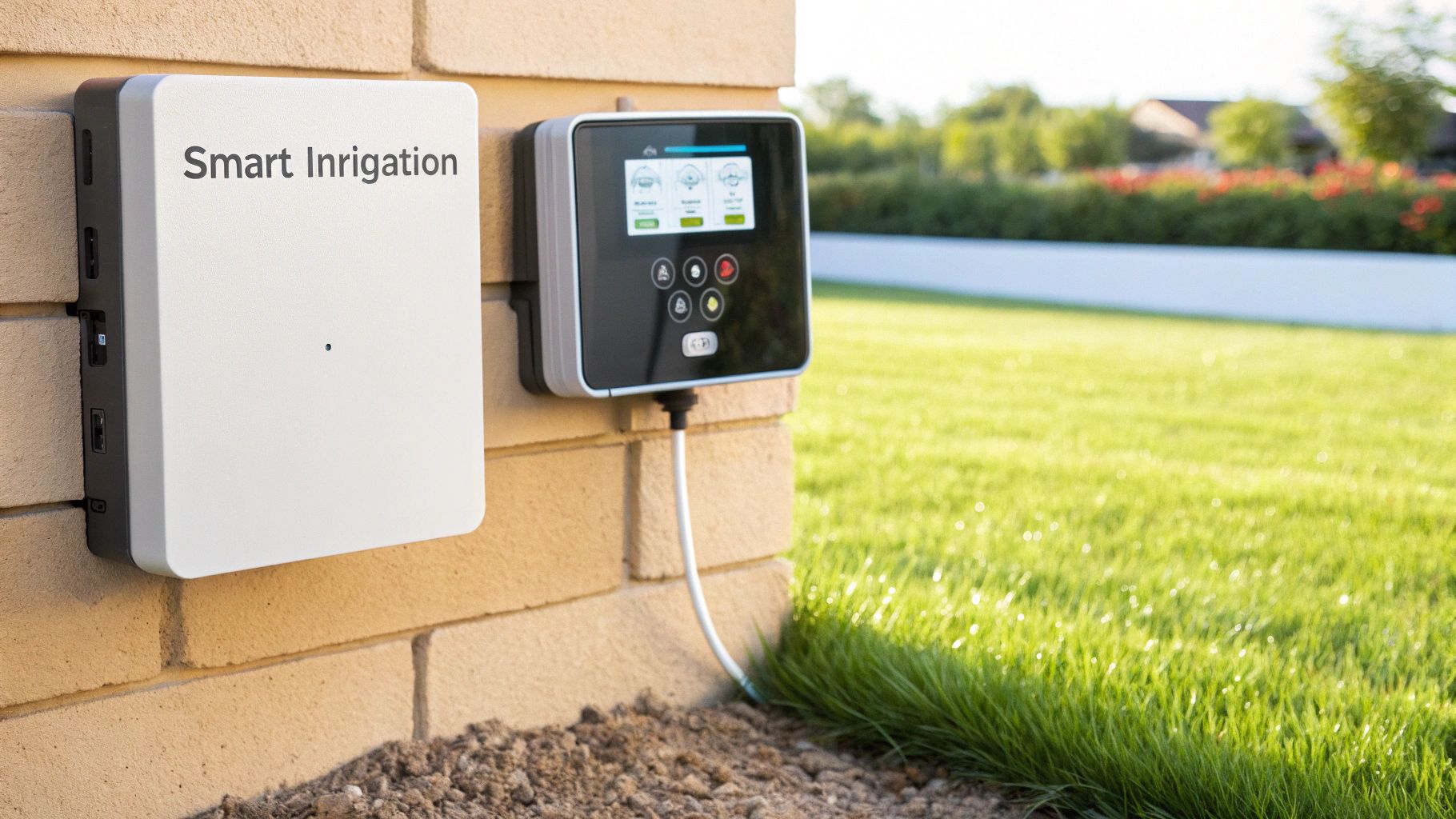
While calculating your output is a major step up from guessing, modern technology offers a far more precise and automated solution. For property owners across South Texas, from San Antonio to Brownsville, smart irrigation systems are a game-changer, removing manual work and uncertainty from the equation.
A smart controller acts as a dedicated water manager for your landscape. Instead of a fixed timer, it connects to the internet to access real-time local weather data. It knows the temperature, humidity, and rainfall predictions, allowing it to automatically adjust your watering schedule—skipping a cycle before a storm or adding more water during a brutal summer heatwave.
Watering That’s Tailored to Your Yard
The true power of these systems is their ability to customize watering for every unique area of your property. When Fischer Landscaping installs a smart system, we do more than just plug in a new controller. We program it with the specific details of your landscape.
We input critical variables for each zone, such as:
- Sprinkler Type: Rotor heads, pop-up sprays, and drip lines all have vastly different output rates.
- Soil Composition: Clay soil in your front yard absorbs water much more slowly than sandy loam in a flower bed.
- Slope and Sun Exposure: A sunny, sloped section of lawn requires a different watering strategy than a flat, shaded area.
This level of detail ensures every part of your landscape receives the exact amount of water it needs without waste. It’s a proactive approach that keeps your property looking its best while significantly reducing your water bill.
The Science Driving It All
The most advanced systems use scientific metrics like evapotranspiration (ET)—a measure of how much water is lost to the atmosphere from soil and plants. Modern sprinkler technology makes this data-driven process more accessible than ever.
For instance, a system can calculate a zone's precipitation rate (PR) using the formula PR = 96.3 × total GPM / area (in ft²). Industry leaders like Rain Bird provide resources showing how professionals apply these calculations to maximize water conservation.
By combining this data, the system knows precisely how long to run to replenish lost moisture—no more, no less. For homeowners and businesses in Corpus Christi, a professionally installed smart irrigation system is one of the smartest investments you can make for a beautiful landscape and responsible water use.
Adapt Your Watering for Local Conditions
A rigid watering schedule doesn't work in the dynamic climate of South Texas. Knowing your sprinkler's output is a great start, but the final piece of the puzzle is adapting that knowledge to your property's unique conditions. Three critical local factors are your soil type, the current season, and your grass type.
Your yard's soil acts like a sponge, and not all sponges are the same. Understanding its behavior is key to determining how long you should run your sprinklers.
Adjusting for South Texas Soil Types
Much of the soil around Corpus Christi and the Coastal Bend has a high clay content. Clay soil is notoriously slow to absorb water. If you apply an inch of water all at once, most of it will run off into the street before it can soak in.
Conversely, sandy soils—more common in other parts of the region—allow water to pass through too quickly. This means they need to be watered more often but for shorter durations to keep moisture available to the roots.
Here’s a practical approach for different soil types:
- Clay Soil: Use the "cycle and soak" method. Instead of running sprinklers for 40 minutes straight, break it into two 20-minute cycles with an hour in between. This gives the stubborn clay time to absorb the water.
- Loam Soil: This is the ideal soil type. Loam balances water retention and drainage, making it perfect for a single, deep watering session.
- Sandy Soil: Water more frequently for shorter periods. For example, apply a half-inch of water three times a week instead of one inch twice a week. This prevents water from draining away before the roots can absorb it.
Syncing Your Schedule with the Seasons
Your lawn's water needs change dramatically throughout the year. The blistering heat of a San Antonio summer requires a much different approach than a mild winter in Brownsville. An effective irrigation plan must be flexible.
During peak summer months (June–August), your lawn is growing rapidly and under constant heat stress. This is when you'll stick to a deep watering schedule of 1 to 1.5 inches per week.
As temperatures cool in the fall, you can begin to reduce watering. By winter, your grass is dormant and may only need water every few weeks, especially if we get some rain. This seasonal adjustment not only keeps your lawn healthy but also saves a significant amount of water. For those establishing new turf, understanding these cycles is vital; our guide on hydroseeding services provides a deeper look into that process.
Seasonal adjustments are crucial for maintaining a healthy lawn without wasting water. Here’s a quick reference guide:
| Season | St. Augustine Grass | Bermuda Grass | General Tip |
|---|---|---|---|
| Spring (Mar-May) | Water 1 inch per week, split into 2 sessions. | Water 1 inch per week, in 1-2 sessions. | Watch for new growth and adjust as temps rise. |
| Summer (Jun-Aug) | Water 1.5 inches per week, split into 2-3 sessions. | Water 1 inch per week, split into 1-2 sessions. | Water early in the morning (4-8 AM) to reduce evaporation. |
| Fall (Sep-Nov) | Reduce to 1 inch per week, then to every 10-14 days. | Reduce to every 10-14 days as it goes dormant. | Gradually decrease watering as temperatures drop. |
| Winter (Dec-Feb) | Water once every 3-4 weeks, only if no rain. | Minimal watering needed; water only if dry for weeks. | Dormant grass needs very little water. Overwatering can cause root rot. |
Remember, these are starting points. Always observe your lawn to see what it needs.
Watering for Your Specific Grass Type
Finally, different grasses have different water requirements. The two most common turf types in South Texas are St. Augustine and Bermuda, and they have distinct needs.
- St. Augustine: This popular, lush grass has a relatively shallow root system, making it less drought-tolerant. It thrives on consistent moisture and shows stress quickly.
- Bermuda Grass: Known for its resilience, Bermuda grows deep roots and has excellent drought tolerance. It can go much longer between waterings without showing significant stress.
Knowing your grass type helps you fine-tune your schedule, ensuring you're giving it exactly what it needs to thrive. A professional landscape consultation can help you identify your grass and soil, setting you up with a truly customized plan for your property.
The Difference Professional Irrigation Management Makes
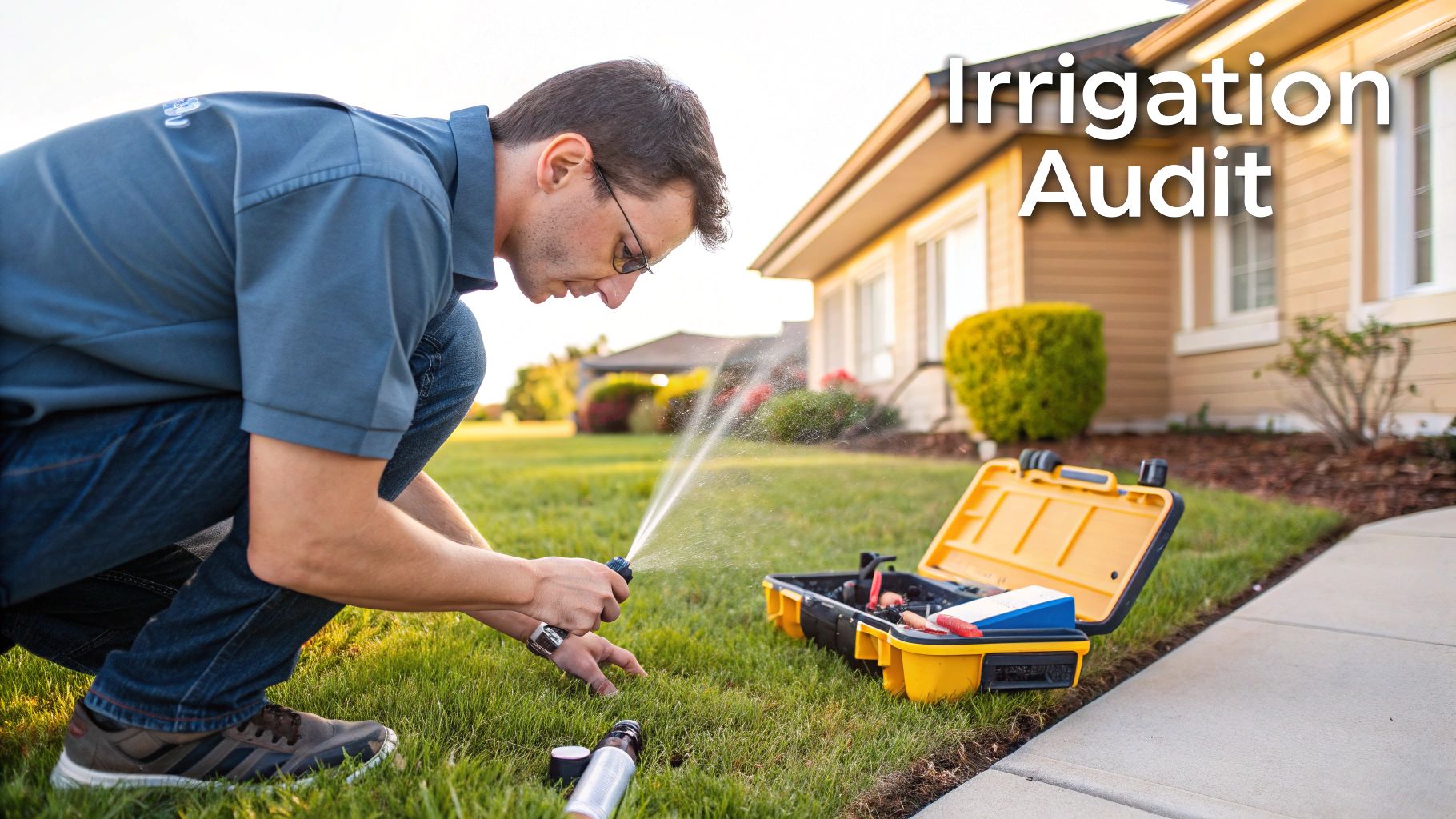
While you can achieve great results with the DIY methods we’ve covered, sometimes you hit a wall. Even with a perfect watering schedule, you might still see stubborn brown spots, soggy patches, or a high water bill. This usually indicates a hidden problem is sabotaging your efforts.
From our experience working with property owners in Corpus Christi and Harlingen, the most frustrating issues are often invisible. Clogged nozzles, subtle pressure imbalances, or poor sprinkler head spacing can completely undermine a healthy lawn. That's when professional expertise pays off.
Going Deeper Than a Simple Timer Setting
At Fischer Landscaping, we address this with a comprehensive irrigation audit. It’s much more than a quick inspection. We conduct a full diagnostic to determine precisely how your system is performing. Our technicians methodically check every component to pinpoint issues that are costing you money and stressing your lawn.
What we look for during an audit:
- Uneven Coverage: We ensure water is distributed evenly across every zone, which is key to eliminating persistent dry spots.
- Pressure Problems: Too much pressure creates a fine mist that evaporates; too little results in weak, doughnut-shaped patterns that miss the roots. We calibrate it for optimal performance.
- Wear and Tear: We identify and fix small issues—a cracked head, a clogged filter, a leaky valve—before they become major, expensive problems.
The Real Payoff of Expert Management
Investing in professional irrigation management pays for itself. A fine-tuned system not only gives you a beautiful, healthy lawn but also conserves one of South Texas's most valuable resources: water. We consider proper irrigation a cornerstone of any quality residential landscaping plan due to its direct impact on property health and curb appeal.
The numbers support this. According to the EPA, a household can reduce its water use by 7,600 gallons annually—a 15% drop—just by adopting more efficient irrigation practices. This is how you achieve the shorter, targeted watering sessions we recommend, running just 2–3 times per week for about 30–45 minutes per zone. You can find more data in the full EPA WaterSense report.
If you're ready to stop guessing and get the most out of your landscape, let our team at Fischer Landscaping help. Contact us today to schedule a professional irrigation audit for your property in San Antonio, Brownsville, or anywhere in between, and see what your landscape is truly capable of.
Your Top Lawn Watering Questions Answered
Even with a solid plan, questions are bound to arise, especially in the challenging South Texas climate. We've compiled answers to the most common questions we hear from homeowners in Corpus Christi and San Antonio.
What’s the Best Time of Day to Water My Lawn in South Texas?
The best time to water is early in the morning, ideally between 4 AM and 10 AM. During this window, the air is cool and winds are calm, which means more water reaches your lawn's roots instead of evaporating.
Watering early also allows the grass blades to dry completely before nightfall. This is crucial because a lawn that stays damp overnight is a breeding ground for fungal diseases like brown patch. Evening watering is a common mistake that can create numerous problems.
Should I Water My Lawn Every Day When It’s Incredibly Hot?
It's tempting, but resist the urge to water your lawn daily, even during a heatwave. This practice encourages shallow, weak roots that can't handle the heat.
Instead, stick to your deep and infrequent watering schedule of two or three times a week. During extreme heat, you may need to add a few more minutes to each session to ensure the water penetrates the sun-baked soil. For properties in Harlingen or Brownsville, a third watering day might be necessary if your lawn shows signs of stress, but always check the soil moisture first.
The goal is to keep the top six inches of soil consistently moist, not to keep the surface soaked. Deep, healthy roots are your lawn's best defense against the punishing Texas summer.
How Can I Tell if I’m Overwatering or Underwatering?
Your lawn will give you signs about its water needs; you just need to know what to look for.
Signs You’re Underwatering:
- Color Change: The grass will turn a grayish or dull, blue-green color.
- The Footprint Test: Walk across your lawn. If your footprints remain visible after a few minutes, the grass blades lack enough water to spring back.
- Hard, Dry Soil: The ground will be visibly dry and hard to the touch.
Signs You’re Overwatering:
- Spongy Feel: The ground feels squishy underfoot, even hours after watering.
- Fungi Growth: A sudden appearance of mushrooms is a classic sign of excessive moisture.
- Weed Invasion: Certain weeds, like nutsedge, thrive in constantly wet soil and will quickly take over.
The screwdriver test is a reliable old-school trick. If you can easily push a long screwdriver six inches into the ground, your soil is likely moist enough. If it requires significant effort, it's time to water.
Still have questions or feel your irrigation system could be more efficient? Let the experts at Fischer Landscaping provide a professional assessment to tune your system for peak performance and a healthier lawn. Request your quote today!