Keeping a South Texas landscape vibrant and healthy, especially with our intense heat and local water restrictions, can feel like a full-time job. The most effective way to win this battle is with a drip irrigation system. It's a network of tubes and emitters that delivers water exactly where it needs to go: right at the base of your plants, directly into the root zone. This targeted approach dramatically reduces water waste and helps your plants build the resilience they need to thrive in our unique climate.
Why Drip Irrigation Is a Game-Changer for South Texas Properties
Rethinking how you water isn't just a weekend project—it's one of the smartest investments you can make for your property's long-term health and value.
Consider traditional sprinklers. In the heat of a Corpus Christi or Harlingen summer, a significant amount of water is lost to wind and evaporation before it even hits the ground. A drip irrigation system, on the other hand, is built on precision.
This targeted delivery results in healthier plants, fewer weeds, and substantial water savings. In fact, professionally designed drip systems can reduce your water use by 30-50% compared to conventional sprinklers. This is a crucial advantage in South Texas, where it also prevents runoff on our common silty and sandy soils.
Practical Benefits for South Texas Homeowners and Businesses
For anyone managing a property from San Antonio down to Brownsville, the practical advantages are clear and compelling:
- Smarter Water Use: By delivering water directly to the root zone, you eliminate waste from overspray and evaporation, which is critical during our long, dry seasons.
- Stronger, Healthier Plants: Consistent, deep watering encourages robust root growth, making plants more resilient to drought and heat stress.
- Fewer Weeds: Since you're only watering your desired plants and not the bare ground between them, you starve weeds of the moisture they need to germinate.
- Navigating Water Restrictions: Drip systems are often subject to different rules during water restrictions and may even be exempt, allowing you to maintain your landscape when others cannot.
This method is also a cornerstone of sustainable landscaping. If your goal is a beautiful, low-maintenance yard that can handle our climate, learning the basics of xeriscaping is another excellent strategy.
Ready to make your landscape more efficient and resilient? Let's walk through the steps of installing a professional-quality drip irrigation system.
Designing Your Drip System for Success
A successful drip irrigation system is built on a solid plan. Taking the time to map out your landscape before purchasing any components will save you significant time and frustration. The best way to begin is by understanding your property's unique needs.
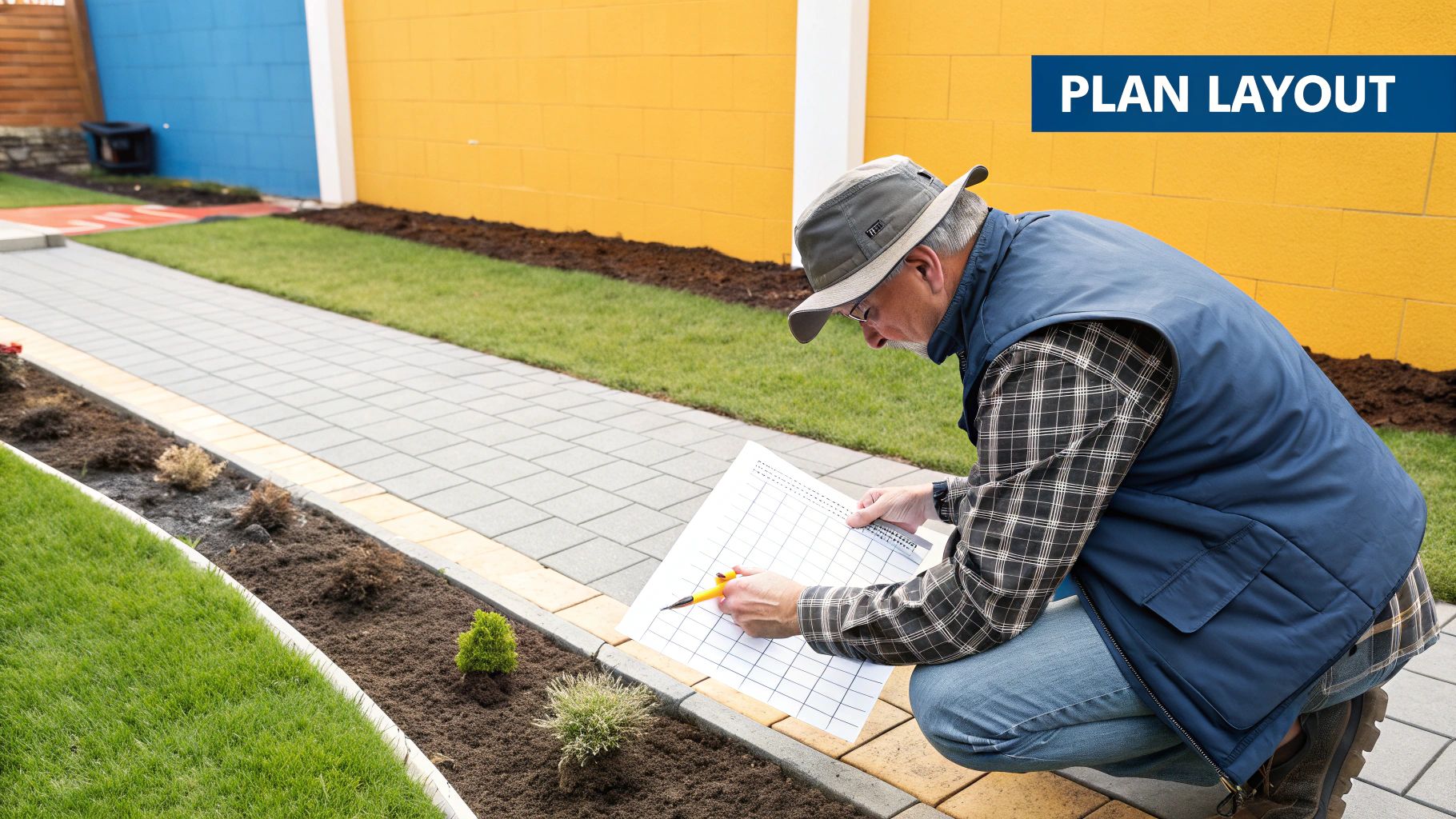
Grab a notepad and walk your property, sketching a basic map of your landscape. Mark the locations of vegetable gardens, flower beds, rows of shrubs, and large trees. This simple diagram will help you break the project into smaller, manageable watering zones.
First Things First: Know Your Water Source
Before you can design an effective system, you must understand your water source's capabilities. Two key measurements are essential for building a system that performs reliably.
- Check Your Water Pressure: Use a simple pressure gauge that screws onto your outdoor spigot to measure your home's PSI (pounds per square inch). Most drip components operate best at a much lower pressure, typically around 20-30 PSI.
- Calculate Your Flow Rate: This is straightforward. Place a 5-gallon bucket under the spigot, turn it on fully, and time how long it takes to fill. Then, divide 300 by the number of seconds it took. The result is your flow rate in gallons per hour (GPH).
These two figures—pressure and flow rate—are the foundation of your design. They determine how many emitters you can run simultaneously within a single zone without compromising performance.
Tailoring the System for Our South Texas Landscape
The unique environment we have here, from the clay soils around San Antonio to the sandy loam near the coast, requires a tailored approach.
For instance, a flower bed with sandy soil near Corpus Christi will drain quickly and benefit from more frequent, shorter watering cycles. Conversely, the heavy clay soil common in the San Antonio area retains moisture longer, making a slow, deep watering schedule more effective.
A professional drip design accounts for these local factors from the start. It’s the difference between merely applying water and watering with precision, giving your landscape exactly what it needs to flourish in our challenging climate.
This focus on water efficiency is a global trend. The drip irrigation market is projected to reach $3.22 billion by 2030, driven by the growing demand for smarter water management solutions, as noted by market insights on MordorIntelligence.com.
To help you choose the right components, we've created a simple guide.
Choosing the Right Emitter for Your South Texas Plants
This table will help you select the correct drip emitter based on plant type and the soil conditions commonly found across the Corpus Christi and San Antonio areas.
| Emitter Type | Best For | Flow Rate (GPH) | Ideal Soil Type |
|---|---|---|---|
| Drippers/Emitters | Individual plants, shrubs, trees, containers | 0.5, 1.0, 2.0 | Best for all soil types; allows precise placement |
| Soaker Hose | Dense plantings, vegetable rows, hedges | Variable, low flow | Excellent for clay soil; provides slow, deep watering |
| Micro-Sprayers | Groundcover, flower beds, sandy soil areas | 5.0 – 25.0 | Good for sandy soil that needs broader, faster coverage |
| Bubblers | Large, established trees and shrubs | 5.0 – 30.0+ | Perfect for deep root watering in any soil type |
Matching the emitter to the plant and soil is the key to an efficient system that keeps your landscape healthy without wasting a drop.
If creating a detailed plan seems overwhelming, our team at Fischer Landscaping is here to help. We specialize in designing custom irrigation systems perfectly matched to your property's specific needs.
Gathering Your Essential Tools and Components
The irrigation aisle at a home improvement store can be intimidating, with its rows of tubing, fittings, and tools. To simplify the process, break the components down into two main categories: the head assembly that controls the water at its source, and the delivery network that distributes it to your plants.
Let's start where your system begins: the outdoor spigot. This is where you'll assemble the "head assembly"—the essential control center for your entire setup.
The Head Assembly: Your System's Command Center
Think of this as the brains of the operation. It’s a series of components screwed together at the spigot, each with a critical function.
- Backflow Preventer: This is a non-negotiable safety device. It’s a one-way valve that ensures irrigation water can never be siphoned back into your home's potable water supply.
- Filter: Even clear tap water contains tiny sediment particles that can clog your drip emitters. A simple screen or disc filter is essential for trapping this debris.
- Pressure Regulator: Your home's water pressure is far too high for a drip system. A pressure regulator reduces it to a safe and effective 25-30 PSI, preventing fittings from blowing apart.
- Tubing Adapter: This final component provides a secure connection between the threaded parts of your head assembly and the main poly tubing.
The Delivery Network: Tubing and Emitters
With the water now filtered and pressure-regulated, it's time to build the network that delivers it to your landscape.
The backbone of your system will be 1/2-inch or 3/4-inch poly tubing. This is your mainline, carrying water from the head assembly to your planting areas. From the mainline, you'll branch off with smaller 1/4-inch distribution tubing (often called "spaghetti tubing") to reach individual plants.
A crucial tip for any South Texas property: invest in high-quality, UV-resistant tubing. The intense sun we get from Corpus Christi up to San Antonio will degrade cheap plastic, causing it to become brittle and crack. Spending a little more on durable materials now will save you from constant repairs later.
Finally, you have the emitters themselves. These small components drip water onto the soil at specific flow rates, typically measured in gallons per hour (GPH). This allows you to provide more water to a thirsty rose bush than a drought-tolerant succulent. You’ll also need various fittings—tees, elbows, and "goof plugs" for sealing mistakes—to connect everything.
Tools That Make the Job Easier
You don't need an extensive toolbox, but a few specialized tools will make the installation process faster and more professional.
- Tubing Cutter: This provides a clean, square cut every time. Using scissors can crimp the tubing, resulting in leaky connections.
- Hole Punch: This purpose-built tool creates the perfect-sized hole in your mainline for inserting emitters or barbed fittings, ensuring a secure seal.
If you'd rather leave the parts list and installation to the experts, the Fischer Landscaping team is ready to design and build a professional-grade system for you. Request a quote today and let our experienced technicians handle the work.
A Practical Guide to Assembling Your Drip System
With your plan complete and your components gathered, it's time to bring your drip irrigation system to life. This is where your careful planning pays off, creating a water-saving network that will keep your landscape thriving. The process is logical: start at the water source and work your way outward.
First, assemble the head assembly—the backflow preventer, filter, pressure regulator, and tubing adapter—and attach it to your spigot. Screw the components together in that order, using plumber's tape on the threads to ensure a watertight seal. This step is essential for protecting your home’s plumbing and ensuring the system operates at the correct pressure.
Laying Out the Mainline Tubing
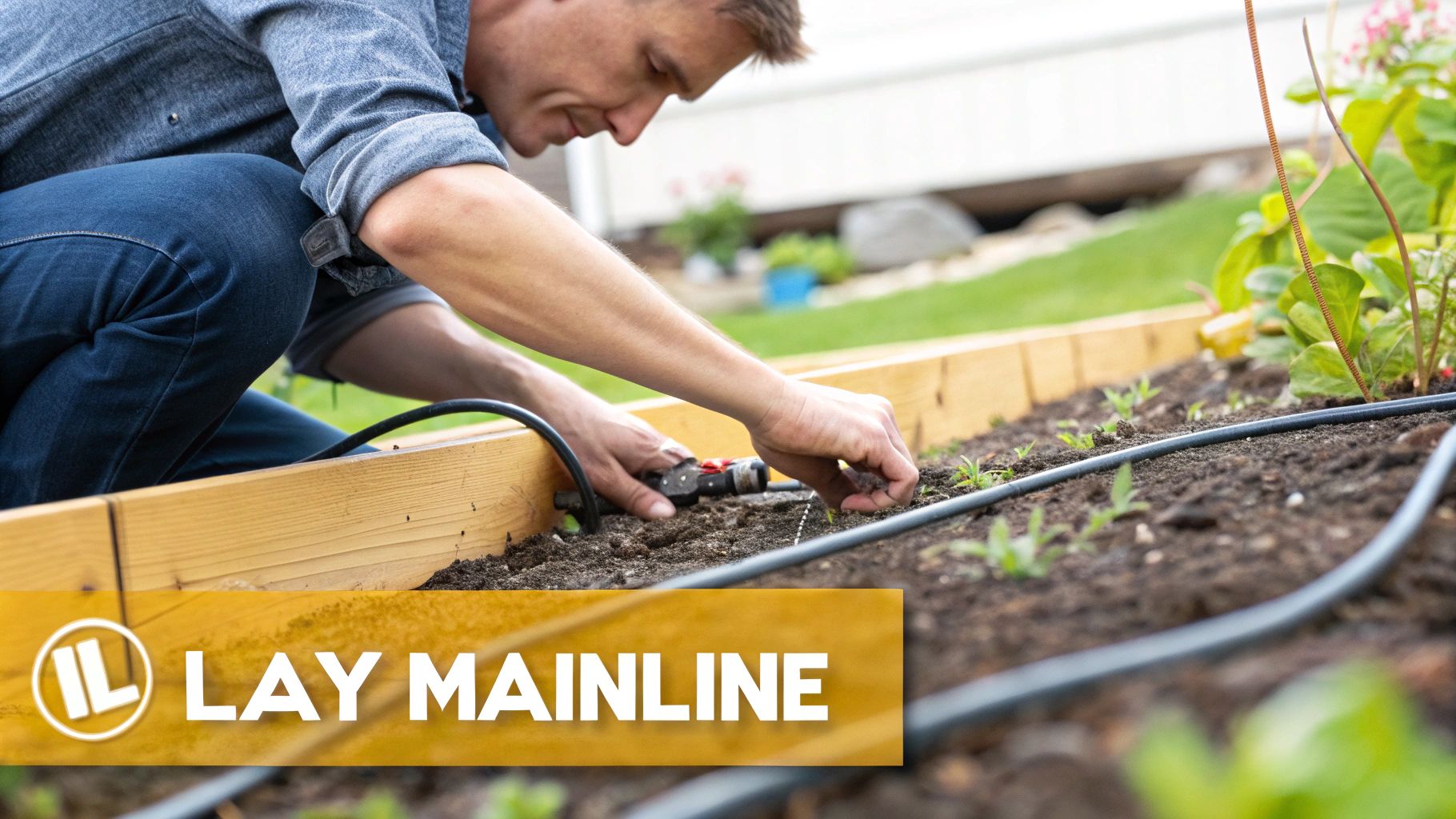
With the head assembly installed, it's time to lay out the main supply line. This 1/2-inch or 3/4-inch poly tubing acts as the system's primary artery, delivering water from the spigot to your garden beds and planting zones.
For easier installation, let the tubing sit in the South Texas sun for an hour or two. The warmth will make the material more flexible and easier to work with.
Lay the mainline according to your plan, running it along the edges of garden beds or walkways. For sharp 90-degree turns, such as navigating a patio corner in a San Antonio backyard, use elbow fittings to prevent kinking the tube. Secure the mainline every few feet with landscape staples, pushing them firmly into the ground to keep the tubing in place and prevent tripping hazards.
Pro Tip: Connecting fittings to poly tubing can be challenging. To make it easier, dip the end of the tubing in a cup of warm water for about 30 seconds. This softens the plastic just enough to slide it onto the barbed fitting with minimal effort, creating a secure, leak-proof connection.
Branching Off with Distribution Lines
Once your mainline is in place, you can start running the smaller 1/4-inch distribution lines, or "spaghetti tubing." These flexible tubes deliver water precisely where it's needed.
Use your hole punch tool to make a clean opening in the side of the mainline tubing. Insert a barbed connector and attach your 1/4-inch line. It’s that simple.
This is where the precision of drip irrigation truly shines. For a raised garden bed in Harlingen, you can run a distribution line down the center and install emitters every 12 inches. For a row of shrubs, you might run a dedicated line to the base of each plant. This modular design is one of the greatest advantages of drip irrigation.
This visual shows the simple process of adding emitters to the line.
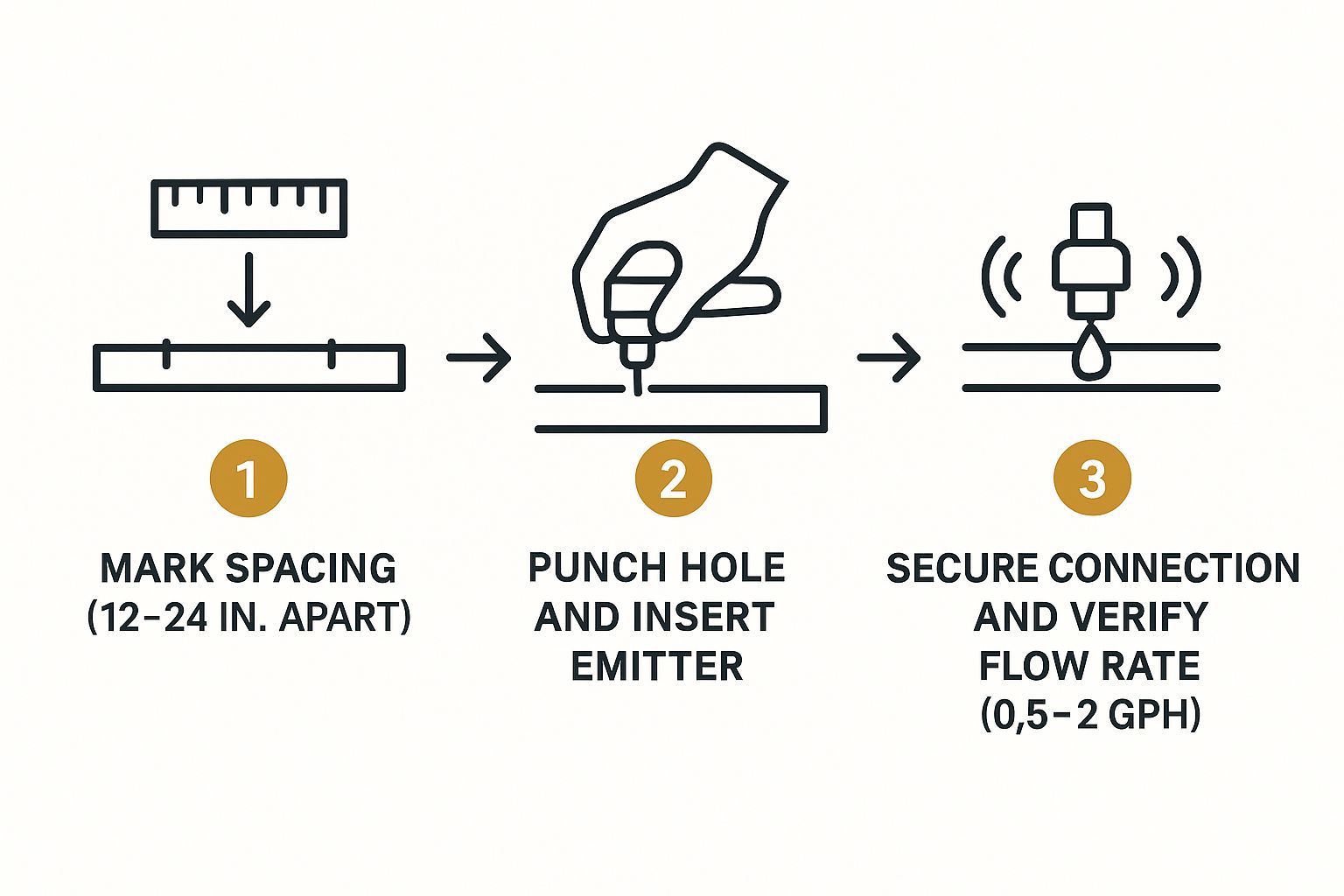
As you can see, proper spacing and a secure connection are all it takes to ensure the emitter delivers the right amount of water directly to the plant's roots.
Achieving a Professional Finish
The goal is to water your plants effectively while making the system itself virtually invisible. Applying a fresh layer of mulch is the perfect way to cover both the mainline and the distribution tubing. This not only creates a clean, professional appearance but also helps the soil retain moisture.
For those interested in advanced DIY techniques, resources on how to build a custom DIY drip irrigation system offer more in-depth guidance. The precision you achieve has a real impact: in agriculture, drip systems have been shown to boost crop yields by 20% to 50%, a powerful testament to the technology's effectiveness.
While a DIY installation is a rewarding project, ensuring a flawless and efficient layout can be challenging. For a professional system designed and installed specifically for your property, our team at Fischer Landscaping offers expert services. We handle everything from design to final testing, giving you confidence that your system is performing at its best.
Testing and Maintaining Your System for Longevity
Installing the last emitter may feel like the end, but the final steps—testing and flushing—are what distinguish a temporary solution from a long-lasting investment. These actions ensure your system runs efficiently for years and prevents common problems before they start.
Before capping the ends of your mainlines, you must flush the entire system. This step is non-negotiable. During installation, it's inevitable that small amounts of dirt or plastic shavings will enter the tubing. If you skip this flush, that debris will immediately clog your new emitters.
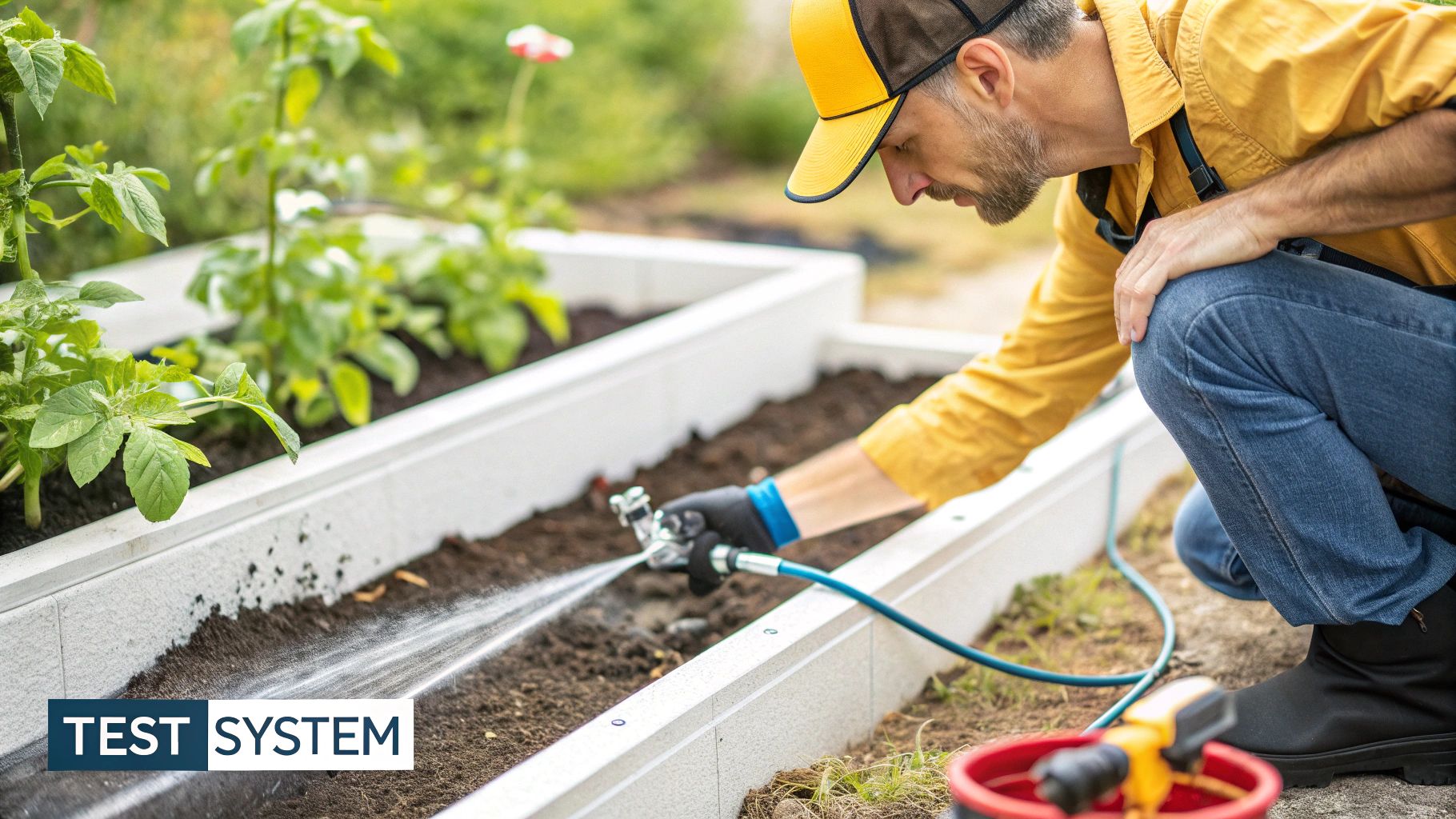
Performing the Initial System Check
Leave the ends of all tubing lines open and turn on the water at the spigot. Let it run for several minutes until the water coming out is completely clear. Once it is, turn the water off and securely install your end caps or figure-eight closures.
Now, it's time for the real test. Turn the water back on and walk the entire length of your system, inspecting for leaks. Check every connection point: the head assembly, every fitting, and each emitter insertion point. If you see a drip or spray, it's usually a sign that a fitting wasn't pushed on securely.
A tiny leak might seem harmless, but over a long, hot South Texas summer, it can waste a significant amount of water and create overwatered, unhealthy patches in your garden. Taking a few extra minutes now to ensure every connection is dry is a wise investment in your system’s efficiency.
Your Seasonal Maintenance Checklist
Drip irrigation is low-maintenance, but not no-maintenance. A little proactive care will keep your system running smoothly and prevent costly issues. Follow this simple checklist:
- Clean the Filter Weekly (First Month): When your system is new, check and clean the filter screen weekly for the first month. Afterward, checking it monthly is usually sufficient.
- Inspect Emitters Seasonally: At the start of each season, run the system and look for clogged emitters (which create dry spots) or damaged ones (which may spray water). Most clogs can be cleared by soaking the emitter in white vinegar.
- Adjust for Plant Growth: As your plants in San Antonio or Brownsville mature, their root zones expand. You may need to add more emitters or reposition existing ones to continue targeting the root system effectively.
- Flush the Lines Annually: Once a year, remove the end caps and flush the entire system to clear out any accumulated sediment. Early spring, before the peak watering season begins, is the perfect time for this task.
Consistent care is the key to a beautiful landscape. For homeowners in the Corpus Christi area who prefer a hands-off approach, understanding what professional landscape maintenance includes can be enlightening. At Fischer Landscaping, our service plans cover every aspect of your irrigation system's health, protecting your investment year after year.
Answering Your Drip Irrigation Questions
Embarking on a new landscaping project naturally brings questions. Drip irrigation is no exception. We've compiled answers to the most common queries we receive from property owners across South Texas.
How Often Should I Run My Drip System in the South Texas Heat?
This is the most frequent question we hear. The correct answer depends on your specific plants and soil type.
For most established plants in areas like Corpus Christi with sandy loam soil, a deep watering session 2-3 times per week is a good starting point during the hottest months. Deep, infrequent watering is far more effective than shallow, daily watering.
For maximum efficiency, always run your system in the early morning to minimize water loss from evaporation. For a truly hands-off solution, a smart controller that automatically adjusts based on local weather conditions is an excellent upgrade. Alternatively, a professional can create a precise watering schedule tailored to your landscape.
Can I Connect a Drip System to My Existing Sprinklers?
Yes, you can. Retrofitting a sprinkler head to create a drip zone is a popular way to water flower beds or shrubs without running a new line from your spigot. Special conversion kits make this process straightforward.
These kits include essential components like a filter and a pressure regulator to reduce the high pressure of a sprinkler line to the low pressure required for drip irrigation. If you're not comfortable with this conversion, our team at Fischer Landscaping can ensure it integrates seamlessly with your existing system.
This hybrid approach is often the most efficient way to manage a diverse landscape. You get the broad coverage of sprinklers for your lawn and the pinpoint accuracy of drip irrigation for gardens, trees, and planters.
Is Drip Irrigation a Good Choice for My Lawn?
While drip irrigation is a game-changer for gardens and trees, it is not typically the best choice for large, open lawns. Subsurface drip lines can be installed for turf, but the process is significantly more complex and expensive than a traditional sprinkler system.
For lawns in areas like San Antonio or Harlingen, you'll achieve more even and cost-effective coverage with a well-designed sprinkler system using modern, high-efficiency rotating nozzles. We almost always recommend a hybrid system: drip irrigation for garden beds and a smart sprinkler system for turf. This approach delivers the best of both worlds for water conservation and landscape health.
Ready to take the guesswork out of watering and create a more resilient landscape? The team at Fischer Landscaping can design and install a custom drip irrigation system that’s perfect for your South Texas property. Contact us today to request a free quote!